If you are comparing an adjustable weight bench review for a home gym, this one stands out for brute-force stability and wide-angle flexibility.
The listing points to a bench built for serious strength work, not just casual accessory use.
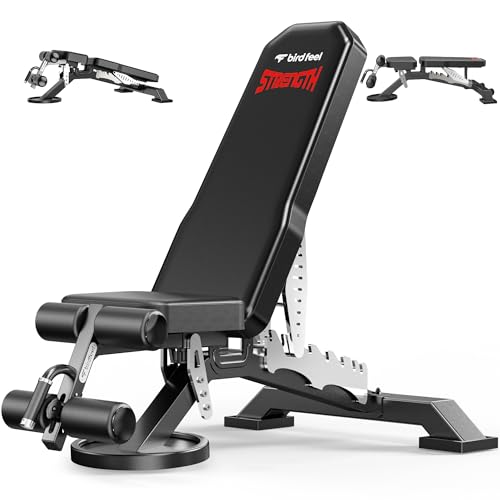
Adjustable Weight Bench Review Summary
The appeal of this adjustable weight bench is simple: it tries to cover the main training positions many home lifters need while keeping the frame heavy-duty and the setup practical.
Based on the listing, it is a strong fit for buyers who want a bench for presses, rows, sit-ups, decline work, and general full-body training without constantly worrying about wobble.
What makes the product attractive is the combination of a claimed 1,800 lb static capacity, a reinforced steel frame, and a backrest that adjusts from decline to upright.
That is the right feature mix for lifters who want one bench to support multiple workout styles.
The removable leg holder also makes it more useful than a basic flat bench if you plan to do ab work or decline movements.
The main tradeoff is that this is still a home-gym bench, so the value comes from versatility and support rather than compactness or simplicity.
If you only need a flat bench for light dumbbell work, this is more bench than you need.
If you want a more complete training station, the design is aligned with that use case.
Review Scorecard
| Category | Score | Buyer assessment |
|---|---|---|
| Stability | 9/10 | Triangular reinforcement, dual-arm support, and vertical stabilizers are all aimed at reducing shake under load. |
| Adjustability | 9/10 | 3 seat positions and 8 backrest angles give broad training coverage from decline to upright. |
| Versatility | 9/10 | Works for presses, dumbbell rows, sit-ups, decline presses, and leg-supported movements. |
| Comfort | 8/10 | Thick foam rollers, padded support, and leather upholstery should help during longer sessions. |
| Ease of setup | 8/10 | 90% pre-assembled packaging and a video guide lower the friction for first-time setup. |
| Mobility | 7/10 | Built-in wheels and handle help, but this is still a heavy-duty bench rather than a minimalist one. |
| Home-gym fit | 9/10 | Strong choice for buyers building a more complete lifting setup in limited space. |
Key Features and Specifications of Adjustable Weight Bench
The most useful spec here is the claimed static weight capacity of up to 1,800 lbs.
That figure, combined with the 70 x 50 mm steel frame, signals a bench intended for demanding strength training rather than occasional accessory use.
The listing also emphasizes a force-bearing triangular structure with dual-arm reinforcements and vertical stabilizers, which is exactly the kind of design language buyers want when they are thinking about heavy pressing.
Other standout details are the adjustability and support features:
- 3 seat positions
- 8 backrest angles
- Decline, flat, and upright positioning
- Removable extended leg rollers
- Thick foam padding on the leg holder
- Soft, odor-resistant, non-slip, wear-resistant leather upholstery
- Built-in transport wheels and handle
- 90% pre-assembled packaging
- Clear instructions plus a step-by-step video guide
- Extra-long back pad for added support
For buyers comparing benches, the more important point is not just that it adjusts, but that it adjusts in a way that supports several common training patterns.
The leg holder makes a difference for decline sit-ups and related movements, while the longer back pad should help users feel more secure during extended sessions.
Pros and Cons of Adjustable Weight Bench
Pros
- Very high claimed load capacity for a home-gym bench.
- Wide adjustment range for decline, flat, and upright work.
- Removable leg holder expands exercise variety.
- Stable frame design is built around reinforcement rather than minimal weight.
- Practical setup features like pre-assembly, wheels, and a handle make ownership easier.
- Comfort-oriented padding and upholstery should suit longer sessions.
Cons
- Likely overbuilt for light users who only need basic dumbbell pressing.
- Bulk and weight are part of the design, so it is not a minimal storage solution.
- The bench’s strengths are training versatility and support, not portability.
- Leg-roller systems are useful only if you actually do decline or supported ab work.
Who Should Buy Adjustable Weight Bench?
This bench makes the most sense for home lifters who want one piece of equipment to handle several movements.
If you do bench pressing, incline work, decline sit-ups, dumbbell rows, and other accessory lifts, the combination of adjustability and stability is the main selling point.
It is also a good fit if you want a bench that feels closer to a commercial-strength setup than a lightweight apartment accessory.
Buy it if you want:
- A heavy-duty adjustable bench for serious home-gym training
- One bench that can cover flat, incline, decline, and upright positions
- Extra support from a reinforced frame and longer back pad
- A removable leg holder for sit-ups and decline work
- A setup that is easier to assemble than many fully built benches
Skip it if you want:
- The smallest possible bench footprint
- A simple flat bench for occasional dumbbell work
- The lightest, easiest-to-move option available
- A bench where you will never use decline or leg-supported exercises
Stability and Adjustment Range of Adjustable Weight Bench
Frame and Load Support
The listing’s strongest selling point is the frame.
The 70 x 50 mm steel build, triangular force-bearing structure, dual-arm reinforcement, and vertical stabilizers are all intended to keep the bench steady under load.
For buyers, that matters more than a flashy feature list because a bench only feels useful when it stays planted during pressing and transitions.
Angle Changes and Workout Coverage
The 3-position seat and 8-angle backrest are the core of the bench’s training range.
That combination should let a user move between decline, flat, and upright positions without needing a separate bench for each role.
The C-lock system is also important because fast adjustment is only useful if it stays precise and stable once locked in.
Leg Support and Ab Work
The removable extended leg rollers are a meaningful addition if sit-ups or decline presses are part of your routine.
The foam padding suggests the design is trying to balance support and comfort, which matters during core work where pressure points become noticeable quickly.
If you never do those movements, this feature becomes less important.
Comfort for Longer Sessions
The extra-long back pad and leather upholstery should help the bench feel more secure and easier to live with over repeated sessions.
The listing claims the cover is odor-resistant, non-slip, and wear-resistant, which is the right set of features for a bench that may be used frequently in a home gym.
Alternatives to Adjustable Weight Bench
If you want a different fit, these are credible alternatives to compare on Amazon:
- Finer Form multi-functional weight bench
- Flybird adjustable bench
- Rep Fitness adjustable bench
- Boreal?
The best alternative depends on what you value most.
Finer Form is worth checking if you want a similar all-in-one bench concept.
Flybird is a common comparison point for lighter home-gym setups.
Rep Fitness is a better place to look if your priority is more premium bench construction.
CAP Barbell is a broad, familiar budget-oriented search direction if you want to compare by price class rather than feature depth.
Is Adjustable Weight Bench Worth It?
Yes, if you want a versatile home-gym bench with a stability-first design.
The listing supports a clear use case: a heavy-duty adjustable bench that can handle pressing, core work, and position changes without feeling like a compromise tool.
It is less compelling if you only need a simple flat bench or if you care more about compact storage than training range.
For buyers who want a serious adjustable bench with strong support features, this is worth considering.