The best plyometric box can add explosive jumps, step-ups, split squats, and conditioning work to a home-gym routine without taking up much space. Our selection of 10 plyometric boxes under $100 includes sturdy wood and steel models alongside forgiving padded options.
Before choosing, consider the box’s height configuration, surface grip, stability, construction, and storage needs. The right design should match your training level while giving you confidence during repeated jumps and landings.
Best 10 Plyometric Boxes Under 100 Picks for 2026
Compact Steel Stability
Rage Fitness 12-Inch Steel Plyo Box

- Pre-assembled steel design
- Rubber anti-slip base and top
- 560-pound maximum weight limit
Best For: Beginners and compact home gyms
Soft 3-in-1 Versatility

- Three adjustable training heights
- Wooden core with EVA foam padding
- 450-pound listed capacity
Best For: Comfort-focused home workouts
Lightweight Foam Training
BalanceFrom 3-in-1 Foam Plyo Box

- 16-, 20-, and 24-inch heights
- Soft high-density foam construction
- Textured non-slip surface
Best For: Portable home HIIT and agility training
Adjustable Wooden Foundation
Yes4All 3-in-1 Wooden Plyo Box

- 12-, 14-, and 16-inch orientations
- 450-pound maximum capacity
- Built-in handles and puzzle-joint assembly
Best For: Rigid indoor home-gym training
Best Adjustable Wood Pick
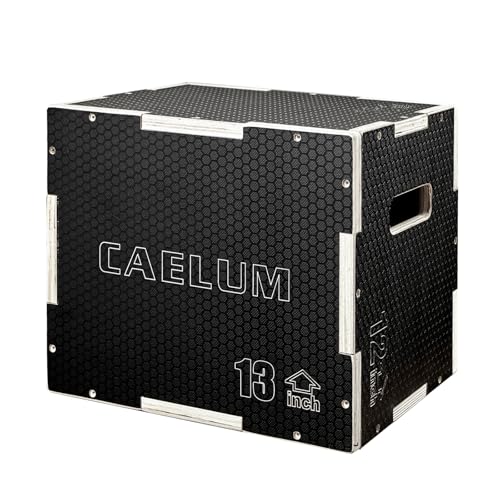
- Three heights: 12, 13, and 16 inches
- 400-pound capacity with textured non-slip top
- Handles and pre-drilled assembly points
Best For: Progressive home or gym training
Best Steel Stability Pick

- Steel trapezoidal design with welded construction
- 500-pound stated weight capacity
- Textured top and rubber feet for traction
Best For: Stable lower-height home-gym training
Best Mainstream Home-Gym Pick
Amazon Basics 3-in-1 Wooden Plyo Box

- Three marked heights: 12, 14, and 16 inches
- 450-pound capacity for indoor training
- Wide handles and pre-drilled assembly holes
Best For: Adjustable home-gym conditioning
Best All-Around Cotton Plyo Box
VEVOR 3-in-1 Plyometric Jump Box

- Three adjustable height settings
- Soft recycled-cotton landing surface
- 220-pound capacity; no assembly required
Best For: Home gym users wanting a cushioned, versatile jump box
Best Lightweight Cushioned Box
OLIXIS 3-in-1 Plyo Jumping Exercise Box

- Three rotating height settings
- Pearl cotton foam cushions landings
- Lightweight and requires no assembly
Best For: Portable home workouts and cushioned conditioning drills
Best High-Capacity Wooden Box
Fitvids Non-Slip Wooden Plyo Box

- 450-pound stated weight capacity
- Three sizes with three height options
- Non-slip plywood puzzle-joint construction
Best For: Strength training with a firm, high-capacity platform
Compact Steel Stability – Rage Fitness 12-Inch Steel Plyo Box
For shoppers comparing plyometric boxes under 100, the Rage Fitness Steel Plyo Box is a compact, pre-assembled option designed for step-ups, box jumps, and conditioning work. Its 12-inch height, steel frame, and rubber contact points emphasize stability in a small footprint.
Best For: Beginners, home-gym users, and anyone who wants a durable fixed-height platform for step-ups and low box jumps.
Pros:
- Heavy-gauge steel construction with a 560-pound maximum weight limit.
- Rubber top and bottom help reduce slipping, wobbling, and tipping.
- Arrives pre-constructed and ready to use.
- Supports box jumps, dips, push-ups, agility work, and step-ups.
Cons:
- Only offers a 12-inch height rather than adjustable levels.
- The compact 12.5-by-12.5-inch top may feel small for some users.
This is a practical choice when stability and minimal setup matter more than height adjustability. Its fixed, low profile suits controlled conditioning and beginner-friendly training.
Soft 3-in-1 Versatility – Yes4All Padded Plyo Box
Among plyometric boxes under 100, the Yes4All Soft-Padded Plyo Box stands out for its three height options and cushioned exterior. A wooden core provides structure, while EVA foam and a vinyl cover offer a softer surface for step-ups and jumping drills.
Best For: Home users who want adjustable training heights with added cushioning for HIIT, step-ups, and box-jump practice.
Pros:
- Three-in-one design provides multiple height options.
- Wooden core supports a listed capacity of up to 450 pounds.
- EVA foam cushioning can make contact more comfortable.
- PVC surface is designed to provide traction and resist water.
Cons:
- The soft exterior may not feel as rigid as a bare wooden or steel box.
- Assembly or setup details may vary by configuration.
The combination of a structured core and padded exterior makes this a balanced option for users prioritizing comfort and versatility. It is especially useful when one box needs to support several training heights.
Lightweight Foam Training – BalanceFrom 3-in-1 Foam Plyo Box
If you are comparing plyometric boxes under 100 for home workouts, the BalanceFrom 3-in-1 Foam Plyometric Jump Box offers 16-, 20-, and 24-inch height options. Its high-density foam construction is lightweight and designed to soften impact during jumps, step-ups, and agility drills.
Best For: Beginners, home users, and athletes who value easy portability and a softer landing surface.
Pros:
- Rotates to provide three jump heights: 16, 20, and 24 inches.
- High-density foam helps soften impact and reduce shin scrapes.
- Textured, non-slip surface supports jumps and step-ups.
- Lightweight design is easy to move and store.
Cons:
- Its listed maximum weight recommendation is 250 pounds.
- Foam construction may provide less rigid support than steel or wood.
This box is a convenient pick for users who want multiple heights without a heavy platform. The softer foam build favors approachable home training, though users seeking maximum rigidity may prefer a harder construction.
Adjustable Wooden Foundation – Yes4All 3-in-1 Wooden Plyo Box
The Yes4All 3-in-1 Wooden Plyo Box is a solid option for shoppers seeking plyometric boxes under 100 with adjustable heights. Its plywood construction supports 12-, 14-, and 16-inch orientations, while built-in handles make repositioning easier during home workouts.
Best For: Users who want a rigid, adjustable box for box jumps, step-ups, split squats, and push-ups.
Pros:
- Three height options allow progression from 12 to 16 inches.
- Durable plywood construction supports up to 450 pounds.
- Pre-drilled holes and puzzle joints simplify assembly.
- Built-in handles help with moving and repositioning the box.
Cons:
- It requires assembly before use.
- At 27 pounds, it is heavier than the foam alternatives.
- It is primarily designed for indoor training.
For shoppers who prefer the firm feel of wood, this model offers useful height changes and a high stated weight capacity. Its main trade-off is the added assembly and heavier weight compared with portable foam designs.
Best Adjustable Wood Pick – CAELUM 3-in-1 Wood Plyo Box
For shoppers comparing plyometric boxes under 100, the CAELUM 3-in-1 offers three compact height options—12, 13, and 16 inches—in a plywood design suited to home or gym workouts. Its textured top and side handles add practical features for jumps, step-ups, and strength training.
Best For: Beginners and intermediate users who want adjustable wooden box-jump heights in a compact format.
Pros:
- Three height options support progressive training.
- Rated for up to 400 pounds.
- Honeycomb-textured surface and sanded edges improve workout grip and comfort.
- Pre-drilled holes, puzzle joints, and handles simplify assembly and moving.
Cons:
- The 12-by-13-by-16-inch model does not have internal support.
- Assembly is required before use.
The CAELUM is a versatile choice when adjustable heights matter, but buyers should pay close attention to the noted lack of internal support on this model and select it according to their training needs.
Best Steel Stability Pick – VEVOR 12-Inch Steel Plyo Box
Among plyometric boxes under 100, this VEVOR model stands out for its steel construction, trapezoidal shape, and 500-pound stated capacity. At 12 inches high, it provides a lower step-up and jump target for home-gym conditioning, strength, and agility work.
Best For: Users who prioritize a steel platform, a lower 12-inch height, and a high stated weight capacity.
Pros:
- Steel tubing and welded construction are designed for stability.
- Supports up to 500 pounds.
- Textured silicone top and four rubber feet help provide traction.
- Can be stacked or disassembled for storage and portability.
Cons:
- This version has one fixed 12-inch level rather than multiple heights.
- Assembly is required.
Choose the VEVOR if a sturdy steel platform and lower training height are more important than adjustable sizing. Its multi-exercise design also makes it useful beyond box jumps.
Best Mainstream Home-Gym Pick – Amazon Basics 3-in-1 Wooden Plyo Box
For a straightforward option among plyometric boxes under 100, the Amazon Basics 3-in-1 wooden box provides 12-, 14-, and 16-inch positions. Clear height indicators, wide handles, and pre-drilled assembly points make it practical for home workouts involving jumps, step-ups, dips, and conditioning.
Best For: Home-gym users who want three clearly marked heights and a familiar, easy-to-move wooden design.
Pros:
- Three heights allow users to adjust workout intensity.
- Supports up to 450 pounds.
- Sanded edges and wide built-in handles improve usability.
- Clear instructions and pre-drilled holes support simpler assembly.
Cons:
- Designed primarily for indoor training and home-gym use.
- Assembly is required.
This is a balanced pick for users who want adjustable wooden training heights without a complicated design. Its indoor-focused construction and 14-by-12-by-16-inch size are worth confirming against your available space.
Best All-Around Cotton Plyo Box – VEVOR 3-in-1 Plyometric Jump Box
For shoppers comparing plyometric boxes under 100, the VEVOR 3-in-1 box is a versatile option with three height settings and a cushioned cotton construction. Its 18-inch maximum height, non-slip surface, and ready-to-use design suit home workouts that combine jumps, step-ups, squats, and upper-body exercises.
Best For: Home gym users who want adjustable heights and a soft, stable landing surface.
Pros:
- Three height settings support progressive training and multiple exercises.
- Recycled cotton filling provides a softer landing surface.
- 1000D grip-pattern mesh helps improve traction.
- No assembly is required, and the PVC cover can be wiped clean.
Cons:
- The maximum height is 18 inches.
- Its 220-pound weight capacity is lower than some wooden alternatives.
- The 27.6-pound construction may be less convenient to move frequently.
This VEVOR model emphasizes comfort, stability, and versatility rather than maximum height or load capacity. It is a practical pick for general conditioning and home strength training, especially if a cushioned box is preferable to a rigid wooden platform.
Best Lightweight Cushioned Box – OLIXIS 3-in-1 Plyo Jumping Exercise Box
Among plyometric boxes under 100, the OLIXIS 3-in-1 stands out for its lightweight design and cushioned landing surface. Rotating the box provides three height settings for jumps, HIIT, step-ups, and other conditioning drills, while the textured cover is designed to improve grip during foot contact.
Best For: Users who need a portable, soft-surface box for home workouts or room-to-room training.
Pros:
- Three height settings accommodate different exercises and training levels.
- Pearl cotton foam helps absorb impact during landings.
- Small and large sizes are available.
- Lightweight construction and no assembly make repositioning easy.
Cons:
- The supplied details do not state a maximum weight capacity.
- The lightweight design may provide less heft than heavier training boxes.
- It has a polyester/Oxford-style cover rather than a rigid wooden platform.
OLIXIS is a convenient choice when portability and landing comfort matter most. Its three-position design supports varied conditioning sessions, though shoppers who prioritize a clearly specified high weight capacity may prefer a different construction.
Best High-Capacity Wooden Box – Fitvids Non-Slip Wooden Plyo Box
For buyers seeking plyometric boxes under 100 with a rigid platform, the Fitvids wooden plyo box offers three size choices and three height options per size. Its puzzle-joint plywood construction supports up to 450 pounds, while the non-slip surface is designed to provide stability during jumps and step-ups.
Best For: Strength-focused users who want a durable wooden box with a high stated weight capacity.
Pros:
- 450-pound maximum weight capacity supports substantial training loads.
- Three height options per size add exercise variety.
- Non-slip surface helps maintain foot stability.
- Plywood puzzle joints are designed for durability.
Cons:
- Assembly is required and takes about 10 minutes.
- The wooden surface is less cushioned than foam- or cotton-filled boxes.
- The supplied 16-by-14-by-16-inch model has a listed maximum height of 24 inches, so size selection matters.
Fitvids is the strongest match here for shoppers who value load capacity and a firm training platform. It requires a brief assembly step and offers less impact cushioning, but its adjustable configurations and wooden construction make it well suited to structured strength and plyometric work.
How We Picked the Best Plyometric Boxes Under 100
We focused on boxes that offer practical value for home workouts while covering different training preferences and experience levels. The lineup includes multi-height designs, fixed-height platforms, steel frames, wooden boxes, and padded models. We prioritized useful height options, non-slip surfaces, stable construction, reasonable portability, and versatility for exercises beyond box jumps.
We also considered setup requirements. Some boxes arrive assembled, while others require basic assembly. That difference can affect convenience, durability, and how easily the box can be stored between workouts.
Quick Comparison
| Design | Best for | Main advantage | Potential trade-off |
|---|---|---|---|
| Wooden 3-in-1 | Versatile home training | Multiple heights and solid feel | Hard landing surface |
| Padded foam | Newer users | More forgiving on missed jumps | May feel less rigid |
| Steel | Frequent, demanding use | Durable frame and consistent support | Can be heavier or less portable |
| Fixed-height | Focused training | Simple setup and predictable height | Less exercise progression |
Key Buying Factors for Plyometric Boxes Under 100
Height and Progression
A 3-in-1 box gives you several heights for gradual progression, warm-ups, step-ups, and more challenging jumps. Beginners may benefit from starting at the lowest setting, while experienced users should verify that the tallest position suits their training goals.
Stability and Weight Capacity
Look for a broad base, reinforced construction, and a clearly stated weight capacity. A box that shifts during takeoff or landing is unsuitable, regardless of its advertised height. Place it on a firm, level, non-slip surface and check fasteners regularly if assembly is required.
Surface Grip and Edge Design
Non-slip tops and textured finishes can improve foot placement, particularly during sweaty workouts. Sharp edges and exposed corners are less desirable for beginners, so padded or carefully finished models may provide greater confidence.
Materials and Landing Feel
Wood and steel generally provide a firm, stable platform, but they can be unforgiving if a jump is missed. Foam or cotton-padded boxes help reduce impact from contact with the sides. They may be preferable for new users, shared spaces, or workouts where safety and comfort take priority.
Storage and Assembly
Check the product’s dimensions, weight, and assembly instructions before buying. A compact box that can be turned onto different sides is useful in smaller rooms, while pre-assembled options save setup time.
Who Should Buy Which Plyometric Boxes Under 100?
Choose a wooden 3-in-1 box if you want the best balance of height variety, durability, and exercise versatility. It is a strong choice for most home-gym users who have enough floor space and can control their landings.
Choose a padded foam or cotton box if you are learning box jumps, train in a shared room, or want a softer surface for accidental contact. Prioritize a stable base and avoid treating padding as a substitute for proper technique.
Choose a steel box if durability and a rigid platform matter most, especially for frequent step-ups, conditioning circuits, and strength-focused training. Confirm its dimensions and weight before committing to a fixed-height model.
Choose a fixed-height platform if you already know the height you need and prefer simple, repeatable workouts. Whichever design you select, begin with controlled step-ups or low jumps, land softly, and leave adequate clearance around the box.