The best heart rate monitor can make training more precise by showing how hard your body is working in real time. The right choice depends on whether you prioritize chest-strap accuracy, wearable convenience, smartwatch features, or basic spot checks.
We compare 10 heart rate monitors and related fitness devices for runners, cyclists, gym users, and anyone who wants more useful activity data without paying for unnecessary features.
Best 10 Heart Rate Monitor Picks for 2026
Most Accurate Chest Strap

- Highly precise heart rate measurement
- Bluetooth, ANT+, and 5 kHz connectivity
- Waterproof with up to 400-hour battery life
Best For: Athletes seeking accurate readings and broad device compatibility
Best for Data-Driven Training

- Real-time heart rate and HRV data
- Adds running dynamics and swim-data storage
- Rechargeable battery lasts up to two months
Best For: Garmin athletes who want detailed performance tracking
Most Comfortable Armband

- Soft, breathable armband design
- Pairs with up to three Bluetooth devices
- 38 hours of operation per charge
Best For: Sports users who prefer an armband over a chest strap
Best Battery Life

- Up to one year of battery life
- User-replaceable battery
- Machine-washable strap with 3 ATM water rating
Best For: Garmin users wanting simple, low-maintenance monitoring
Long-Range Chest Strap Pick
GEOID HS500 Heart Rate Monitor

- ANT+ and Bluetooth compatibility
- Up to 800 hours of replaceable-battery life
- IP67-rated chest-strap design
Best For: Frequent runners, cyclists, and app-based training
Everyday Wellness Pick
Fitness Tracker with Heart Rate Monitor

- Tracks heart rate, sleep, steps, and blood oxygen
- IP68 water resistance for daily wear
- Up to five days of rechargeable battery life
Best For: Everyday activity and wellness tracking
Training Accuracy Pick
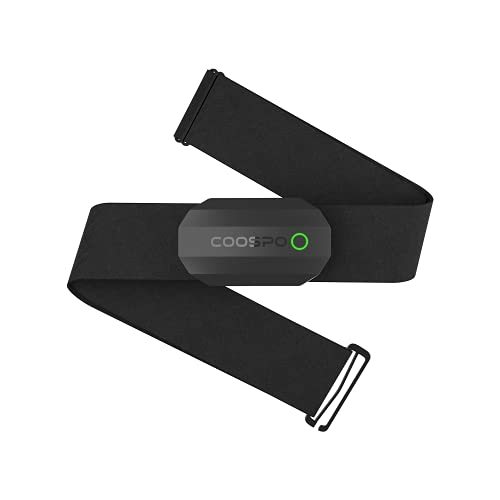
- Advertised ±1 BPM accuracy
- Bluetooth and ANT+ connectivity
- Up to 300 hours with a replaceable CR2032
Best For: Structured training with fitness apps and bike computers
Simple Spot Check

- Large OLED screen with pulse and SpO2 readings
- One-button operation with auto power-off
- Batteries and lanyard included
Best For: Portable spot checks at home, during exercise, or outdoors
Connected Daily Wear

- Heart rate and sleep monitoring with 120 sports modes
- Bluetooth calls, notifications, and music control
- 1.83-inch display with 5–7 days of active battery use
Best For: Connected fitness and everyday smartwatch use
Long-Wear Wellness Tracking

- 24/7 heart rate plus sleep and wellness metrics
- 25 sport modes with Keep Health app logging
- 5 ATM waterproofing and 10–14 days of regular use
Best For: Extended fitness, sleep, and water-resistant activity tracking
Most Accurate Chest Strap – Polar H10
The Polar H10 is a strong choice if you want a heart rate monitor built around measurement precision, broad compatibility, and flexible connections. Its chest strap supports Bluetooth, ANT+, and 5 kHz connectivity, while built-in memory and waterproofing add versatility for varied workouts.
Best For: Athletes who prioritize highly accurate readings and compatibility with multiple devices or fitness machines.
Pros:
- Recognized for highly precise heart rate measurement.
- Supports Bluetooth, ANT+, and 5 kHz connections, including simultaneous connections.
- Waterproof design with internal memory for multiple hours of activity.
- Battery life is rated at up to 400 hours.
Cons:
- Chest-strap design may be less appealing than an armband for some users.
- Requires a CR2025 battery; other battery sizes may damage the sensor.
The Polar H10 stands out for users who want a dependable, connection-friendly heart rate monitor and do not mind wearing a chest strap. Its extensive compatibility and long battery life make it especially practical for structured training.
Best for Data-Driven Training – Garmin HRM 600
The Garmin HRM 600 is a feature-rich heart rate monitor for athletes who want more than basic pulse data. Along with real-time heart rate and HRV, it records workouts without a watch and supports running dynamics, swim data, and daily metrics through Garmin Connect.
Best For: Garmin users focused on detailed running, swimming, and performance data.
Pros:
- Transmits real-time heart rate and HRV data to compatible devices and apps.
- Records workouts when a watch cannot be worn and syncs them to Garmin Connect.
- Supports running dynamics, indoor pace and distance, and swim-data storage.
- Machine-washable strap with a rechargeable battery lasting up to two months.
Cons:
- Advanced features require compatible Garmin equipment or a smartwatch.
- Battery life is shorter than models using replaceable batteries.
The HRM 600 is the most capable option here for Garmin-centered training ecosystems. Choose it if workout recording and advanced performance metrics matter more to you than maximum battery longevity.
Most Comfortable Armband – COROS Heart Rate Monitor
The COROS Heart Rate Monitor offers an armband alternative to a traditional chest strap. This heart rate monitor uses Bluetooth to connect with up to three devices at once, and its wear detection, breathable band, and automatic power control are designed for convenient workout use.
Best For: Athletes who prefer a soft, easy-to-clean armband for sports and activity tracking.
Pros:
- Soft, breathable fabric band is designed for comfortable wear.
- Can connect simultaneously with up to three Bluetooth devices.
- Wear detection automatically powers the monitor on and off.
- Provides 38 hours of operation or up to 80 days of standby time per charge.
Cons:
- Bluetooth only; it is not compatible with ANT+.
- Designed for sports and activities rather than daily heart rate tracking.
- Large-band sizing fits arms from 9.4 to 16.9 inches.
The COROS model is a practical pick when comfort and quick setup are priorities. Its main limitation is connectivity: users who rely on ANT+ equipment should consider another option.
Best Battery Life – Garmin HRM 200
The Garmin HRM 200 is a straightforward heart rate monitor for users who want accurate real-time heart rate and HRV data without frequent charging. It works with compatible Garmin devices, fitness equipment, and apps, while its machine-washable strap and user-replaceable battery simplify maintenance.
Best For: Garmin users who want a durable, low-maintenance monitor for regular training.
Pros:
- Transmits real-time heart rate and HRV data to compatible devices and apps.
- Offers up to one year of battery life.
- Uses a user-replaceable battery for convenient maintenance.
- Machine-washable strap with a 3 ATM water rating.
Cons:
- Advanced compatibility is centered on Garmin devices, equipment, and supported apps.
- Does not include the additional running-dynamics features listed for the HRM 600.
The HRM 200 is a sensible everyday option for Garmin-compatible training setups. Its year-long battery life, washable strap, and durable water rating make it appealing for users who value simplicity and minimal upkeep.
Long-Range Chest Strap Pick – GEOID HS500 Heart Rate Monitor
The GEOID HS500 is a practical heart rate monitor for athletes who want real-time readings without relying on a smartwatch. Its chest-strap design supports ANT+ and Bluetooth connections, while the 800-hour replaceable-battery life suits frequent training.
Best For: Running, cycling, fitness, and users connecting a heart rate monitor to multiple apps or fitness devices.
Pros:
- Supports both ANT+ and Bluetooth connections.
- Provides up to 800 hours of battery life with a replaceable CR2032 battery.
- IP67 water resistance and movement-focused algorithms support active workouts.
- LED feedback confirms connection and readiness.
Cons:
- Swimming is not recommended.
- Bluetooth should be connected through the fitness app rather than directly through phone settings.
The HS500 stands out for broad device compatibility, long battery life, and quick wake-up time. It is a strong choice when dependable workout tracking matters more than having a built-in display.
Everyday Wellness Pick – Fitness Tracker with Heart Rate Monitor
This wrist-worn fitness tracker combines a heart rate monitor with step, distance, calorie, blood-oxygen, and sleep tracking. Its compact display, activity features, and phone notifications make it suited to everyday wellness monitoring rather than focused chest-strap training.
Best For: Users who want a general-purpose fitness tracker with heart rate, sleep, activity, and notification features.
Pros:
- Tracks heart rate, blood oxygen, steps, calories, distance, and sleep stages.
- IP68 water resistance supports hand washing and swimming, though prolonged soaking is discouraged.
- Displays call and message notifications from compatible phones.
- Rechargeable battery provides up to five days of use.
Cons:
- It requires charging about every five days rather than using a replaceable coin-cell battery.
- The supplied notes do not specify workout heart-rate accuracy or ANT+ connectivity.
- Hot baths and saunas are not recommended while wearing it.
This tracker is a convenient all-day option for monitoring several basic health and activity metrics from the wrist. Choose it for broader lifestyle features, but consider a dedicated chest strap for more specialized training connectivity.
Training Accuracy Pick – COOSPO H808S Chest Strap
The COOSPO H808S is a focused heart rate monitor for exercise sessions, using a chest strap to provide real-time readings. It supports Bluetooth 4.0 and ANT+ connections, making it useful with sports watches, bike computers, and several third-party fitness apps.
Best For: Athletes training with Peloton, Zwift, Strava, Wahoo, sports watches, or bike computers.
Pros:
- Advertised to provide heart-rate readings within ±1 BPM.
- Dual Bluetooth 4.0 and ANT+ transmission supports multiple device types.
- IP67 waterproof construction and LED indicators support workout use.
- Replaceable CR2032 battery offers up to 300 hours of use.
Cons:
- The electrode zones should be moistened before use.
- The chest strap is recommended for replacement after six months or 300 washes.
- Users must connect through the fitness app rather than the phone’s standard Bluetooth menu.
With dual-mode connectivity and a training-oriented chest-strap format, the H808S is a sensible pick for structured workouts. Its battery life is shorter than some alternatives, but the replaceable cell and wide app support add convenience.
Simple Spot Check – Fingertip Pulse Oximeter
This fingertip pulse oximeter is a straightforward heart rate monitor for quick pulse and blood oxygen checks at home, during workouts, or on outdoor trips. Its large OLED display, one-button operation, and included batteries make it ready to use without setup or an app.
Best For: Adults who want a portable heart rate and SpO2 spot-checking device with an easy-to-read screen.
Pros:
- Large digits display pulse rate, SpO2, and signal strength.
- Waveform bar graph provides a visual indication of pulse strength.
- Compact design, lanyard, batteries, and auto power-off support convenient everyday use.
Cons:
- Provides spot readings rather than continuous activity or sleep tracking.
- It is designed for finger measurements and does not offer smartwatch features.
Choose this model if you value simplicity and quick readings over connected features. The stated 70%–100% SpO2 measuring range and ±2% accuracy specification add useful product detail, while the included AAA batteries let you start immediately.
Connected Daily Wear – TG08 Smartwatch
The TG08 is a smartwatch-style heart rate monitor for people who want wellness tracking alongside everyday phone features. It combines heart rate and sleep monitoring with 120 sports modes, Bluetooth calls, notifications, and music control in a 1.83-inch display.
Best For: iPhone and Android users seeking an all-purpose fitness watch with broad activity tracking and smart conveniences.
Pros:
- Tracks heart rate and sleep while supporting 120 sports modes.
- 1.83-inch HD display offers customizable watch faces.
- Bluetooth calling, notifications, music control, and a 350mAh battery rated for 5–7 days of active use.
Cons:
- IP67 protection is suited to splashes, sweat, and brief submersion, rather than the stronger 5 ATM rating offered by some fitness trackers.
- Step recording starts after exceeding 20 steps.
This is the more versatile choice for users who want a heart rate monitor integrated into a connected watch. Its feature set is broad, though buyers focused mainly on simple pulse readings may prefer a dedicated fingertip device.
Long-Wear Wellness Tracking – Zeacool Fitness Tracker
The Zeacool Fitness Tracker is a heart rate monitor designed for continuous-style wellness tracking and activity logging. Along with 24/7 heart rate monitoring, it records blood oxygen, blood pressure, sleep, temperature, steps, distance, and calories through the tracker and its Keep Health app.
Best For: Users who want extended wear, swimming-friendly water resistance, and a broad set of health and activity measurements.
Pros:
- Offers 24/7 heart rate monitoring plus blood oxygen, blood pressure, temperature, and sleep tracking.
- Supports 25 sport modes and daily activity metrics in the Keep Health app.
- 5 ATM waterproofing and a stated 10–14 days of regular-use battery life suit active wear.
Cons:
- The 1.10-inch display is smaller than the TG08 smartwatch’s screen.
- Health data and additional functions rely on the companion app and smartphone compatibility.
- The supplied notes do not provide measurement accuracy specifications.
This tracker stands out for users prioritizing long battery life, water resistance, and a wide range of wellness metrics. It is a practical fit for ongoing activity and sleep monitoring, especially if you are comfortable using the Keep Health app.
How We Picked the Best Heart Rate Monitors
We focused on the features that matter most in everyday training: heart-rate accuracy, connection options, comfort, battery life, water resistance, compatibility, and ease of use. Chest straps generally provide faster, more consistent readings during intense exercise, while watches and fitness trackers offer broader health and activity features. Fingertip pulse oximeters are better suited to quick, stationary checks than continuous workout tracking.
We also considered whether each device supports common standards such as Bluetooth and ANT+, since broad compatibility makes it easier to connect with phones, watches, bike computers, gym equipment, and fitness apps.
Quick Comparison
| Type | Best For | Main Advantage | Potential Limitation |
|---|---|---|---|
| Chest strap | Structured training | Accurate, responsive readings | Requires wearing a strap |
| Armband or wearable sensor | Comfort-focused workouts | Less restrictive than a chest strap | May vary by placement and activity |
| Smartwatch or fitness tracker | All-day health tracking | Heart rate, steps, sleep, and notifications | Wrist readings can lag during intervals |
| Pulse oximeter | Occasional spot checks | Simple readings from a fingertip | Not designed for continuous training |
Key Heart Rate Monitor Buying Factors
Accuracy and Sensor Placement
For running intervals, cycling, rowing, and other high-intensity workouts, a snug chest strap is usually the most dependable option. Wrist-based devices are more convenient, but fit, skin contact, movement, tattoos, and temperature can affect readings.
Connectivity and Compatibility
Check whether the monitor supports Bluetooth, ANT+, or both. Bluetooth is convenient for phones and many apps, while ANT+ is useful for bike computers, compatible watches, and gym equipment. Confirm support for your specific device before buying.
Comfort, Battery, and Durability
Look for an adjustable strap, a secure fit, and a sensor that is easy to remove for washing. Rechargeable models reduce battery waste, while replaceable-cell designs can be convenient for long-term use. Water resistance matters if you sweat heavily, train outdoors, or swim.
Features Beyond Heart Rate
Decide whether you need only live heart-rate data or also want sleep tracking, step counting, blood oxygen readings, notifications, GPS, and sports modes. Extra features are useful only when they fit your routine and are presented clearly in the companion app.
Who Should Buy Which Heart Rate Monitor?
Choose a chest-strap Heart Rate Monitor if training accuracy is your top priority, especially for intervals, racing, cycling, or structured zones. Choose an armband or compact sensor if you want a less restrictive fit while maintaining workout-focused tracking. Choose a smartwatch or fitness tracker if you want one device for heart rate, sleep, steps, notifications, and general activity. Choose a fingertip pulse oximeter for occasional resting measurements rather than exercise monitoring.
Before ordering, confirm app support, device compatibility, sizing, water-resistance claims, and the difference between continuous tracking and on-demand readings. The best option is the one that provides reliable data in the activities you actually perform and is comfortable enough to use consistently.