Tight calves can affect walking, running, squatting, and overall foot comfort. The best calf stretchers for home make it easier to perform consistent mobility work without relying on a gym or complicated setup.
This roundup compares 10 practical options, from compact foot rockers to adjustable wooden slant boards. We focus on stability, adjustability, portability, comfort, and weight capacity so you can choose a model that fits your routine.
Best 10 Calf Stretchers for Home Picks for 2026
Physician-Trusted Rocker

- Rocker design targets calves, feet, and lower-leg tissues
- Slip-resistant pads help keep it stable
- Fits adult shoes up to size 12; 250-lb limit
Best For: Targeted calf and foot stretching with a compact rocker
Adjustable Wooden Platform

- Five incline settings from 15 to 35 degrees
- Wooden platform with anti-slip safety treads
- Side handle and no assembly required
Best For: Progressive stretching and multi-purpose mobility exercises
Comfort-Focused Foot Rocker

- Curved surface supports a deeper, comfortable stretch
- Nonslip surface promotes stability
- Supports 300 lb and shoe sizes up to 12.5
Best For: Lightweight, beginner-friendly calf and foot stretching
High-Capacity Adjustable Board
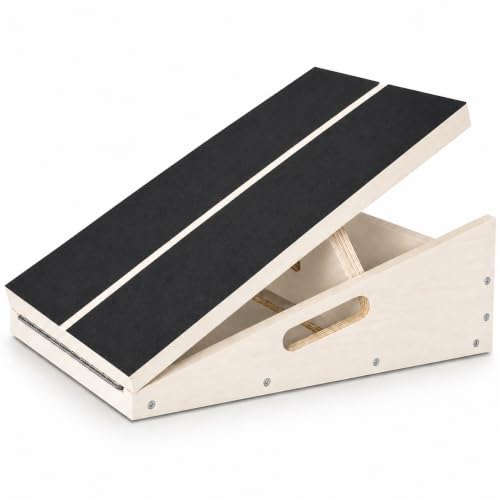
- Five adjustable angles from 15 to 35 degrees
- Stated 500-lb capacity with reinforced wood construction
- Includes side handles, exercise guide, and three-year warranty
Best For: Sturdy, progressive stretching and broader home workouts
Deep-Stretch Pick

- Heel lock targets a deeper calf stretch
- Supports 300+ pounds and folds flat
- Slip-resistant pad and door-jam groove
Best For: Targeted calf and Achilles stretching at home
Adjustable Wooden Pick

- Five incline settings from 23° to 45°
- Supports up to 460 pounds
- Textured surface and EVA base add traction
Best For: Adjustable stretching and lower-body mobility
Versatile Foam Set

- Three pieces create five stretching angles
- EPP foam supports up to 480 pounds
- Portable, non-slip, and easy to clean
Best For: Flexible home stretching and mobility routines
Best Adjustable Wooden Wedge

- Four incline settings from 20° to 40°
- 500-pound wooden construction
- Portable design with carry handle
Best For: Adjustable home stretching, squats, and ankle mobility
Best Folding Calf Stretcher

- Folding frame with magnetic closure
- Four angles from 20° to 40°
- 500-pound capacity with grip pads
Best For: Portable stretching and compact home storage
Best Higher-Incline Therapy Board

- Four settings from 30° to 45°
- Lightweight at about 4.5 to 5 pounds
- Suitable for home and therapy use
Best For: Steeper stretching, squats, and rehabilitation routines
Physician-Trusted Rocker – ProStretch Original
If you want one of the more focused calf stretchers for home, the ProStretch Original uses a rocker design to position the foot for a deeper lower-leg stretch. It is intended for tight calves and common foot- and lower-leg concerns, with slip-resistant rubber strips for added stability.
Best For: Adults seeking a compact, targeted calf and foot stretch tool for home routines, rehabilitation, or sports flexibility work.
Pros:
- Rocker design helps isolate and stretch the lower-leg muscles, tendons, and ligaments.
- Slip-resistant pads help prevent movement during use.
- APMA accepted and used in physical therapy clinics, according to the supplied product information.
- Made in the U.S.A. and includes access to a stretching guide by QR code.
Cons:
- Fits adult shoes only up to size 12.
- Recommended weight limit is 250 pounds.
- Must be used while wearing socks and rubber-soled athletic shoes.
The ProStretch Original is a straightforward choice when precise foot positioning matters more than adjustability. Its size and footwear requirements are worth checking before purchase.
Adjustable Wooden Platform – StrongTek Wooden Slant Board
The StrongTek Wooden Slant Board is a versatile option among calf stretchers for home, offering five incline settings from 15 to 35 degrees. Its larger standing platform, textured safety tread, and side handle also make it suitable for mobility drills, warm-ups, and rehabilitation exercises.
Best For: Users who want an adjustable, full-size wooden board for calf stretching, ankle mobility, squats, and recovery work.
Pros:
- Five adjustable angles—15, 20, 25, 30, and 35 degrees—allow stretch progression.
- Anti-slip safety treads help provide secure foot placement.
- High-quality Lauan hardwood plywood construction is designed for durability.
- Side handle supports portability, and no assembly is required.
Cons:
- At 9 pounds, it is heavier than compact plastic foot rockers.
- The 16-by-12.5-inch platform may require more storage space.
- Its free-standing design is less specialized than a dedicated rocker.
Choose this board if adjustability and exercise versatility are priorities. It is a practical fit for home users who want one platform for stretching, squats, and mobility work.
Comfort-Focused Foot Rocker – Calf Stretcher Foot Rocker
This foot rocker is a compact pick among calf stretchers for home, designed to target the calves, ankles, and feet. Its curved surface and angled construction support foot positioning for a deeper stretch, while the nonslip surface helps provide a steady base.
Best For: Beginners, seniors, and active users who want a lightweight foot rocker for flexibility and lower-leg mobility routines.
Pros:
- Curved ergonomic surface is designed to contour to the foot and reduce joint strain.
- Angled construction supports consistent foot positioning during stretching.
- Supports up to 300 pounds and fits shoe sizes up to 12.5 U.S.
- Lightweight plastic construction makes it easy to move around the home.
Cons:
- It is not adjustable like a multi-angle slant board.
- The 180-day warranty is shorter than the three-year warranty listed for one competing board.
- Its compact foot-rocker format offers less exercise versatility than a full platform.
The rocker format makes this a convenient choice for simple, repeatable stretches. Consider it when portability and foot comfort matter more than adjustable angles or strength-training use.
High-Capacity Adjustable Board – Wooden Calf Stretch Board
For shoppers comparing calf stretchers for home, this wooden slant board combines five angle settings with a stated 500-pound capacity. The textured top and slip-resistant base support controlled calf stretching, ankle mobility, calf raises, squats, and warm-up exercises.
Best For: Home or gym users who need a sturdy, adjustable platform for stretching, mobility training, rehabilitation, and strength exercises.
Pros:
- Five settings from 15 to 35 degrees accommodate gentler or more advanced stretching.
- Reinforced wooden construction has a stated 500-pound capacity.
- Textured top and slip-resistant base help improve foot contact and stability.
- Side handles, an exercise guide, and a three-year warranty add practical value.
Cons:
- At 3.85 kg, it is less lightweight than a compact plastic rocker.
- The wooden platform takes more storage space than a small dedicated foot stretcher.
- Its broader exercise design may be more than needed for basic calf stretching.
This is the strongest choice in the group for users who prioritize capacity and adjustability. Its platform design also makes it useful beyond calf stretching, provided you have room to store it.
Deep-Stretch Pick – CalfPRO Slant Board
For shoppers comparing calf stretchers for home, the CalfPRO stands out for its targeted, physical-therapy-inspired design. Its heel lock holds the heel as a pivot for a deeper calf stretch, while the slip-resistant pad and door-jam groove help provide a secure setup.
Best For: Users seeking a compact, deeper calf and Achilles stretch, including people managing everyday tightness or supporting plantar-fasciitis-focused routines.
Pros:
- Heel-lock design supports a deeper, controlled stretch.
- Heavy-duty ABS construction supports more than 300 pounds.
- Folds flat and includes a grippy door-jam groove for portability and stability.
- Can support calf, ankle, foot, and lower-leg mobility routines.
Cons:
- Its specialized heel-lock design may take more adjustment than a basic wedge.
- It provides one primary stretching setup rather than multiple incline angles.
The CalfPRO is a strong choice when controlled positioning and portability matter more than adjustable angles. Its design is especially suited to short daily stretching sessions at home or on the go.
Adjustable Wooden Pick – Portable 5-Angle Slant Board
This wooden slant board is a practical option among calf stretchers for home, especially for users who want to adjust stretching intensity. Five incline settings from 23 to 45 degrees let you choose a position for calf work, ankle mobility, warmups, cooldowns, or squat variations.
Best For: Users who want a sturdy, adjustable incline board for stretching, rehabilitation exercises, and lower-body mobility.
Pros:
- Offers five adjustable angles: 23°, 30°, 35°, 40°, and 45°.
- 11-ply poplar construction supports up to 460 pounds.
- Textured PVC surface and non-slip EVA base add traction.
- Includes a training poster and instruction guide and requires no tools.
Cons:
- At about 4.5 pounds, it is less lightweight than foam stretch wedges.
- The wooden board has a larger, more structured form than a compact foot stretcher.
With its broad angle range and high stated weight capacity, this board offers flexibility for gradually adjusting your routine. It is a good fit for home users who also want a platform for squats and general mobility work.
Versatile Foam Set – Yesland 3-Piece Slant Boards
The Yesland set gives home users three foam pieces that can be combined for different stretching positions. With five possible angle configurations, these calf stretchers for home can support calf and foot routines as well as squats, rehabilitation exercises, and mobility work.
Best For: Users who want a lightweight, stackable set for adjustable calf stretching, foot and ankle routines, or multi-use home workouts.
Pros:
- Three-piece design supports five configurations from 8.5 to 34 degrees, plus a flat 180-degree arrangement.
- Solid EPP foam is rated to hold up to 480 pounds without deforming.
- Non-slip, waterproof, oil-proof, and easy-to-clean construction.
- Portable for use at home, the office, gym, or yoga sessions.
Cons:
- The separate pieces need to be positioned or stacked before use.
- Foam construction may provide a different feel from a rigid wooden board.
This set is appealing for shoppers who value configuration flexibility and portability. Its stackable design makes it easy to vary the angle as your stretching routine changes, while the foam construction keeps the setup simple to clean and move.
Best Adjustable Wooden Wedge – TEMI Slant Board
If you want calf stretchers for home that can also support squats and ankle-mobility work, the TEMI Slant Board offers four incline settings in a compact wooden design. Its non-slip surface, built-in handle, and 500-pound capacity make it practical for regular stretching and balance exercises.
Best For: Home users who want an adjustable board for calf stretching, squats, heel stretches, and ankle-mobility drills.
Pros:
- Four adjustable angles: 20°, 25°, 30°, and 40°.
- High-density hardwood construction supports up to 500 pounds.
- Built-in handle and approximately 5-pound weight make it portable.
- Non-slip surface supports stable positioning during exercise.
Cons:
- Its wooden construction may be less compact than a foldable design.
- The supplied dimensions indicate a relatively broad footprint for small spaces.
The TEMI stands out for its sturdy construction and versatile angle range. It is a solid choice if you want one calf stretcher for home that can also fit into strength, balance, and rehabilitation routines.
Best Folding Calf Stretcher – Frylr Slant Board
For shoppers seeking calf stretchers for home that are easy to store, the Frylr Slant Board combines a folding frame with a magnetic closure and carry handle. It offers four fixed angles, a non-slip foot surface, and a 500-pound capacity for stretching, warm-ups, and mobility work.
Best For: People who need a portable, foldable board for home, office, gym, or travel use.
Pros:
- Folds for compact storage and includes a magnetic closure.
- Four angle settings: 20°, 25°, 30°, and 40°.
- 12-layer wood construction supports up to 500 pounds.
- Non-slip surface and bottom grip pads help create a planted setup.
Cons:
- It weighs about 5 pounds, so it is portable but not ultralight.
- The folding design may require setup before each use.
The Frylr is the most storage-friendly option in this group. Its foldable construction and adjustable incline make it especially useful when you want a calf stretcher that can move between rooms or travel with you.
Best Higher-Incline Therapy Board – Portable Wooden Slant Board
This portable wooden slant board is among the more straightforward calf stretchers for home, with four higher incline positions from 30° to 45°. At about 4.5 to 5 pounds, it can be used at home, in an office, gym, or physical-therapy setting for stretching and weight-bearing exercises.
Best For: Beginners and experienced users who want a lightweight board with steeper incline settings for stretching and rehabilitation routines.
Pros:
- Four adjustable positions: 30°, 35°, 40°, and 45°.
- Lightweight wooden design is easy to transport.
- Suitable for home, office, gym, and physiotherapy use.
- Can support stretching, squats, mobility work, and rehabilitation exercises.
Cons:
- Its lowest 30° setting is steeper than the other boards in this roundup.
- The supplied notes do not specify a weight capacity or non-slip surface.
This board is a practical pick if you prefer steeper inclines or want a lightweight option for multiple locations. Because its lowest angle is 30°, it may be better suited to users comfortable with a more pronounced stretch.
How We Picked the Best Calf Stretchers for Home
We evaluated these calf stretchers by looking at the features that matter most during regular home use: platform stability, angle adjustment, surface grip, construction, portability, and ease of storage. We also considered whether each design supports more than calf stretching, such as ankle-mobility drills, squats, physical-therapy exercises, and foot-rolling movements.
Rocker-style stretchers can be convenient for targeted foot and calf work, while slant boards generally offer a broader standing platform and more control over stretching intensity. Weight capacity and base design are especially important because a stretcher should remain steady rather than slide or flex under load.
Quick Comparison
| Type | Best For | Main Advantage | Potential Limitation |
|---|---|---|---|
| Foot rocker | Focused calf and plantar-fascia exercises | Compact and simple to use | Usually offers less angle adjustment |
| Fixed wooden slant board | Basic stretching and squats | Stable, durable platform | One primary incline |
| Adjustable slant board | Progressive mobility training | Multiple intensity levels | Can take more setup and storage space |
| Foldable or portable board | Travel and small spaces | Easier to store and carry | Hinges and locking parts need careful inspection |
Key Buying Factors for Calf Stretchers for Home
Adjustability
An adjustable incline lets you begin with a gentler stretch and increase the angle as mobility improves. Fixed boards can work well if you already know the position you prefer, but they provide less flexibility for different users or exercises.
Stability and Grip
Look for a wide base, non-slip feet, textured surfaces, or secure padding. A stable board is more useful than an aggressive incline that makes you feel unbalanced. Place it on a firm, level floor and avoid slick rugs unless the manufacturer specifically supports that use.
Construction and Capacity
Wooden boards often provide a solid feel for standing exercises, while molded plastic or padded rocker designs may be lighter. Check the listed weight capacity and dimensions, especially if the board will also be used for squats, rehabilitation, or balance work.
Comfort and Portability
Edges, padding, and foot placement affect how easily you can hold a stretch. If you plan to store the device between sessions, consider folding mechanisms, carrying handles, and overall weight. Compact rocker models are convenient, while larger boards may offer better support.
Who Should Buy Which Calf Stretchers for Home?
Choose a rocker-style calf stretcher if you want a compact tool for foot, ankle, and calf exercises or need something that can stay beside a desk. Choose a fixed wooden slant board if you value straightforward setup, a firm platform, and a lower-maintenance design.
An adjustable slant board is the better choice for households with multiple users or anyone following a progressive flexibility routine. A foldable portable model makes sense for people with limited storage or those who want to take their equipment to classes, appointments, or travel.
Whichever design you choose, start with a comfortable angle, keep movements controlled, and stop if you experience sharp pain, numbness, or worsening symptoms. If you are recovering from an injury or managing persistent foot pain, ask a qualified clinician how to use calf stretchers safely.