The right stretching strap can make mobility work more controlled, repeatable, and easier to personalize. Looped designs help athletes target specific muscle groups, while non-elastic straps provide steady resistance during warmups, cooldowns, and physical therapy exercises.
We selected 10 stretching straps for athletes with different loop layouts, lengths, materials, and instruction options. Use the guide below to match a strap to your sport, flexibility goals, and preferred stretching routine.
Best 10 Stretching Straps for Athletes Picks for 2026
Elastic PNF Pick
Therapist’s Choice Stretch Strap

- Elastic design supports contract-relax stretching.
- Toe and large loops target feet and major muscle groups.
- Includes an instructional manual for partner-free stretching.
Best For: Athletes wanting elastic assistance for PNF and lower-body stretching.
Proven Training Classic

- Non-elastic nylon strap offers controlled tension.
- Ten loops and a six-foot length support varied exercises.
- Includes a 40-page booklet and video guide.
Best For: Athletes seeking a versatile strap for mobility, yoga, and recovery.
Rehab-Friendly Value

- Non-elastic construction avoids snap-back and recoil.
- Evenly spaced loops help control stretching intensity.
- Long, lightweight format suits home, gym, clinic, or travel.
Best For: Controlled mobility work, physical therapy, and recovery stretching.
Wide-Grip Mobility Tool
12-Loop Physical Therapy Strap

- Twelve loops offer varied hand and foot positions.
- Eight-foot, 1.5-inch-wide design provides leverage and grip.
- Includes an instruction manual and storage bag.
Best For: Athletes focused on recovery, rehabilitation, and extensive mobility work.
Durable Cotton Pick
Tune Up Fitness Double Loop Strap

- Heavy-duty 100% cotton construction
- Double loops for versatile stretching
- Compact 5-foot travel-friendly design
Best For: Yoga, mobility work, and physical therapy
Most Adjustable Option
Trideer Stretching Strap with Loops

- 10 numbered loops for precise positioning
- Padded neoprene handles improve grip comfort
- Includes guide cards and a storage bag
Best For: Structured mobility, rehabilitation, and travel
Beginner-Friendly Value
Oak-Sports Non-Elastic Yoga Strap

- 10 loops support adjustable stretching
- Stable non-elastic polyester design
- Lightweight 75-inch format for beginners
Best For: General flexibility, yoga, and post-workout recovery
Looped Mobility Pick
SANKUU 12-Loop Stretching Strap

- 12 loops for adjustable stretch positions
- Durable 8-foot nylon construction
- Includes storage bag and workout poster
Best For: Athletes seeking versatile warmup, mobility, and recovery stretching
Adjustable Tension Choice
AZURELIFE Half-Elastic Stretch Strap

- Elastic and non-elastic sides
- 11 loops for gradual progression
- Includes six-exercise guide and 12-month warranty
Best For: Athletes wanting flexible tension options in a portable strap
Extended Non-Elastic Option
Abiarst 10-Loop Stretching Strap
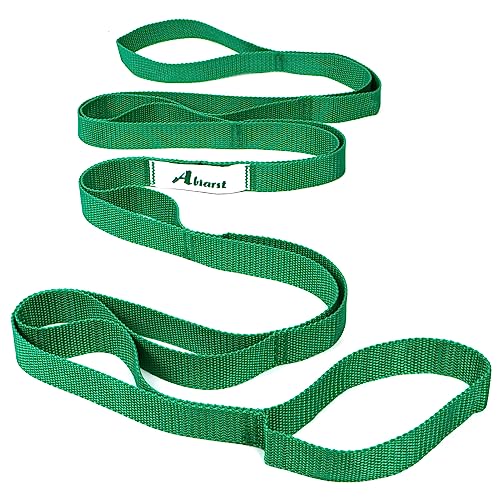
- 10 spacious loops on a 75-inch strap
- Washable fabric resists fraying
- Useful for fitness, Pilates, and therapy
Best For: Athletes preferring simple, longer-reach non-elastic stretching
Elastic PNF Pick – Therapist’s Choice Stretch Strap
For athletes comparing stretching straps for athletes, the Therapist’s Choice model stands out for its elastic construction and loop variety. Its slight give can make contract-relax and static stretching more comfortable, while the toe and larger loops support targeted lower-body work.
Best For: Athletes who want elastic assistance for PNF stretching, hamstring work, calf and foot stretches, and general flexibility training.
Pros:
- Elastic design supports contract-relax stretching and provides slight give during static stretches.
- End toe loops allow targeted foot, plantar fascia, and heel stretches.
- Includes larger loops for hamstrings, quadriceps, hips, calves, shoulders, and back.
- Comes with a basic instructional manual and supports partner-free PNF stretching.
Cons:
- At approximately 50 inches, it is shorter than several long non-elastic strap options.
- Product contains latex, which may matter to users with latex sensitivities.
This is a useful choice when you prefer a little elasticity rather than a completely fixed strap. The combination of toe and larger loops makes it particularly adaptable for lower-body mobility routines.
Proven Training Classic – OPTP Stretch Out Strap
The OPTP Stretch Out Strap is a non-elastic option for athletes comparing stretching straps for athletes, mobility tools, and recovery accessories. Its six-foot length and ten durable loops provide multiple positions, while the included exercise booklet and video guide add structure to home, gym, or therapy routines.
Best For: Athletes who want a durable, non-elastic strap for warm-ups, cool-downs, yoga, Pilates, physical therapy, and mobility work.
Pros:
- Non-elastic nylon construction allows controlled stretching without strap give.
- Ten loops provide numerous hand and foot positions for varied exercises.
- Six-foot length works for lower- and upper-body stretching.
- Includes a 40-page exercise booklet and video stretching guide.
Cons:
- It does not provide the assisted elasticity some users may prefer.
- The strap is imported, although the product is stated to be made in the USA.
With its long format, loop layout, and substantial guidance materials, this is a practical all-purpose strap for athletes who value repeatable positioning and a fixed, controlled feel.
Rehab-Friendly Value – Trideer Loop Stretching Strap
For athletes comparing stretching straps for athletes with rehabilitation needs, the Trideer strap emphasizes controlled, non-elastic movement. Its evenly spaced loops help adjust intensity without snap-back, making it suitable for hamstring, IT band, knee, back, and full-body mobility work.
Best For: Athletes and active users doing physical therapy, post-surgery range-of-motion work, yoga, or controlled daily mobility training.
Pros:
- Non-elastic design gives users direct control over tension and avoids recoil.
- Evenly spaced loops support gradual intensity adjustments as flexibility improves.
- Reinforced woven webbing is designed for repeated pulling and daily use.
- At 75 inches long, it is portable for the gym, clinic, or travel.
Cons:
- It does not offer the elastic assistance of stretch bands with built-in give.
- The product description lists both 75 and 81 inches in different details, so exact length should be verified.
This strap fits users who prioritize predictable tension and loop-based positioning. Its longer format and compact weight make it a practical mobility tool for both training and recovery routines.
Wide-Grip Mobility Tool – 12-Loop Physical Therapy Strap
This wide 12-loop strap is a strong option for athletes comparing stretching straps for athletes who want extensive positioning choices. Its eight-foot length, 1.5-inch width, sweat-resistant SBR surface, storage bag, and instruction manual are suited to recovery, mobility, and rehabilitation routines.
Best For: Athletes needing a wide-grip, long strap for PNF stretching, lower-back and hamstring mobility, shoulder traction, hip work, and post-workout recovery.
Pros:
- Twelve reinforced loops create multiple hand and foot positions.
- Eight-foot length provides room for varied stretches and leverage.
- Wide SBR construction is designed to reduce digging into the skin and provide a comfortable grip.
- Includes an instruction manual and storage bag for guided, portable use.
Cons:
- Its 1.5-inch width and eight-foot length may be more substantial than needed for simple routines.
- The strap is non-elastic, so it will not provide elastic assistance.
This model is best suited to users who want a broad grip and many adjustment points. The combination of length, loop count, and included storage makes it especially practical for structured recovery and mobility programs.
Durable Cotton Pick – Tune Up Fitness Double Loop Strap
For athletes seeking stretching straps for athletes that can support mobility work and recovery, the Tune Up Fitness strap offers a durable, compact design. Its 5-foot cotton construction and loops on both ends suit leg, shoulder, hamstring, and general stretching routines.
Best For: Athletes who want a sturdy, travel-friendly strap for yoga, flexibility training, and physical therapy exercises.
Pros:
- Made from heavy-duty 100% cotton.
- Double-loop design supports varied poses and stretches.
- Rolls up easily for gym bags or suitcases.
- Can also support shoulder, chest, leg, and hamstring stretching.
Cons:
- At 5 feet, it is shorter than many looped stretching straps.
- It has loops only at both ends rather than multiple numbered loops along the strap.
This is a practical choice for athletes who prioritize durable cotton construction and portability over an extended, highly adjustable loop layout.
Most Adjustable Option – Trideer Stretching Strap with Loops
The Trideer is a strong contender among stretching straps for athletes who want precise positioning during flexibility and recovery work. Its long nylon strap has 10 numbered loops, padded neoprene handles, and included guidance materials for use across stretching, yoga, Pilates, and rehabilitation.
Best For: Athletes who want an extended strap with numbered loops, comfortable handles, and portable recovery guidance.
Pros:
- 10 numbered loops help track stretching positions.
- Full-wrapped neoprene handles provide a more comfortable grip.
- Thickened nylon construction and tight stitching support durability.
- Includes a detachable 32-page guide card set, drawstring bag, and foldable poster.
Cons:
- The 81-inch length may be more strap than some users need.
- At 1.5 inches wide and 12.8 ounces, it may feel bulkier than simpler straps.
With its numbered loop system and travel accessories, the Trideer is well suited to athletes who value repeatable positioning and structured stretching sessions.
Beginner-Friendly Value – Oak-Sports Non-Elastic Yoga Strap
For athletes comparing stretching straps for athletes on a budget, this Oak-Sports model provides a straightforward non-elastic design with 10 loops. Its 75-inch length and 1-inch width offer accessible support for post-workout stretching, yoga, Pilates, dance, gymnastics, and physical therapy.
Best For: Beginners and active users who want a lightweight, easy-to-use strap for general flexibility and recovery work.
Pros:
- Non-elastic nylon construction offers stable resistance.
- 10 loops allow users to adjust hand and foot placement.
- 75-inch length is suitable for a range of stretching exercises.
- Includes a 12-month worry-free service promise.
Cons:
- The 1-inch width is narrower than some heavy-duty stretching straps.
- It does not list padded handles, a storage bag, or included exercise guidance.
This strap keeps the design simple and lightweight, making it a sensible option for beginners who need loop adjustability without added accessories.
Looped Mobility Pick – SANKUU 12-Loop Stretching Strap
For athletes comparing stretching straps for athletes, the SANKUU stands out for its 12-loop layout, generous 8-foot length, and included workout poster. Its nylon construction and multiple hand or foot positions make it practical for warmups, flexibility work, Pilates, gymnastics, and assisted stretching.
Best For: Athletes who want a versatile, long loop strap for warmups, mobility sessions, and recovery-focused stretching.
Pros:
- 12 individual loops support varied stretch positions and progression.
- Durable nylon construction is designed to resist ripping, fraying, and shape loss.
- Includes a nylon storage bag and workout poster for portability and guidance.
- At 98 inches long and 1.57 inches wide, it offers ample reach for many users.
Cons:
- The non-elastic strap does not provide the accommodating feel of an elastic band.
- Its longer length may be more than some users need for compact routines.
The SANKUU is a strong all-purpose choice when loop variety and portability matter. Its 12-loop design can help athletes adjust positioning as flexibility improves, while the included accessories make it convenient to use outside the gym.
Adjustable Tension Choice – AZURELIFE Half-Elastic Stretch Strap
The AZURELIFE gives athletes a choice between elastic and non-elastic tension in one compact strap. For anyone shopping for stretching straps for athletes, its 11 loops and two-sided construction allow you to change resistance and gradually increase the challenge across yoga, Pilates, dance, CrossFit, or physical therapy exercises.
Best For: Athletes who want to switch between gentler elastic assistance and firmer non-elastic stretching.
Pros:
- Two-sided design offers elastic and non-elastic stretching options.
- 11 individual loops support gradual progression and varied positioning.
- Double-lock seams and thick materials are designed for durability.
- Includes an illustrated guide with six exercises and a 12-month warranty.
Cons:
- At 68 inches long, it provides less reach than the longer straps in this roundup.
- The 1-inch width may offer less hand coverage than wider models.
This strap is the most adaptable option for athletes who do not want to commit to a single tension style. The half-elastic construction makes it especially useful for progressing exercises while keeping the strap compact and portable.
Extended Non-Elastic Option – Abiarst 10-Loop Stretching Strap
The Abiarst is a straightforward non-elastic strap with 10 loops and an extended 75-inch length. Among stretching straps for athletes, it suits users who want extra room for hamstring, flexibility, Pilates, dance, gymnastics, or physical-therapy routines without adding elastic resistance.
Best For: Athletes who prefer a simple, washable non-elastic strap with longer-than-standard loops.
Pros:
- Each loop is designed to provide more room for stretching than standard multi-loop straps.
- Durable, tight-knit fabric is described as washable, skin-friendly, and resistant to fraying.
- 10 loops support multiple positions for flexibility and recovery work.
- Its 75-inch length offers useful reach while remaining relatively compact.
Cons:
- The non-elastic design does not offer adjustable resistance or stretch assistance.
- It is 1 inch wide, narrower than the SANKUU strap.
The Abiarst keeps the design simple and practical. Its longer loops can be helpful for athletes who need more room to position their hands or feet, while the washable fabric is convenient for regular training use.
How We Picked the Best Stretching Straps for Athletes
We focused on practical features that affect everyday use: loop placement, strap length, width, resistance style, grip, portability, and included instructions. The lineup includes non-elastic straps for precise positioning, multi-loop designs for varied hand and foot placement, and a half-elastic option for athletes who want some give during movement.
We also considered whether each strap suits warmups, post-training mobility, rehabilitation exercises, or general flexibility work. A useful strap should be easy to control without encouraging forceful stretching or awkward positioning.
Quick Comparison
| Best For | Look For |
|---|---|
| Precise flexibility work | Non-elastic construction and clearly spaced loops |
| Travel and regular training | Lightweight design with a compact profile |
| Beginners | Exercise guides, posters, or numbered loops |
| Long-limbed athletes | Approximately 8 feet of usable length |
| Gentler assisted stretching | A half-elastic or slightly flexible strap |
Key Buying Factors for Stretching Straps for Athletes
Loop Configuration
Multiple loops let you adjust leverage in small increments and maintain a secure grip. More loops are useful for changing exercises, but simple designs may be easier to understand and pack.
Elasticity and Control
Non-elastic straps provide consistent feedback and are often preferable for controlled hamstring, shoulder, hip, and calf stretches. Elastic models can feel more forgiving, but they may change tension as they extend. Choose based on your coach’s or physical therapist’s recommendations.
Length, Width, and Durability
Longer straps accommodate taller users and larger ranges of motion. A wider strap may distribute pressure more comfortably, while reinforced stitching and strong loop seams matter when the strap is used frequently.
Instructions and Portability
Printed exercise guides, posters, or included books can help beginners establish safer positioning. For athletes who travel, prioritize a strap that folds or rolls easily without excessive bulk.
Who Should Buy Which Stretching Straps for Athletes?
- For structured mobility routines: Choose a multi-loop strap with clear loop spacing and exercise guidance.
- For physical therapy or rehabilitation: Favor a non-elastic design that allows slow, measured adjustments, unless your clinician recommends otherwise.
- For dancers, gymnasts, and flexibility-focused athletes: Look for a long strap with enough loops to support gradual range-of-motion work.
- For yoga and general workouts: A lightweight looped strap offers useful versatility for shoulders, hips, hamstrings, and calves.
- For athletes who prefer softer assistance: Consider a half-elastic option, while still maintaining controlled tension and avoiding painful stretching.
Whichever model you choose, use the strap as a positioning aid rather than a tool for forcing range of motion. Move gradually, stop at sharp or worsening pain, and follow professional guidance when recovering from an injury.