The best slant boards can make calf stretching, heel-elevated squats, ankle-mobility work, and posture-focused activities more comfortable and consistent. The right model depends on your intended use, preferred incline, available space, and required weight capacity.
We selected 10 slant boards covering adjustable wooden designs, portable wedges, resistance-band options, and a writing-focused model so you can match the board to your routine and budget.
Best 10 Slant Boards Picks for 2026
Best Overall Wooden Slant Board

- Five incline settings from 15° to 35°
- Durable hardwood plywood construction
- Non-slip treads and side carry handle
Best For: Home stretching, squats, and rehabilitation exercises
Best Lightweight Foam Slant Board

- Lightweight EPP foam construction
- Five angle options for progressive stretching
- Foldable and easy to clean
Best For: Travel, office use, and compact physical therapy routines
Best Foldable Wooden Slant Board

- 13-inch-wide platform for natural foot placement
- Five settings from 15° to 35°
- Folds with an integrated carry handle
Best For: Strength training, mobility work, and compact home-gym storage
Best Heavy-Duty Slant Board

- Extra-wide 19.7-inch hardwood platform
- Supplied capacity rating of up to 1,000 pounds
- Full anti-slip top, baffle, and base
Best For: Heavy squats, ATG training, and wide-stance stretching
Best Writing Slant Board

- Fixed 20-degree writing angle
- Lightweight, stackable plastic design
- Removable clip holds up to 20 sheets
Best For: Children’s writing, reading, and classroom use
Best Adjustable Slant Board
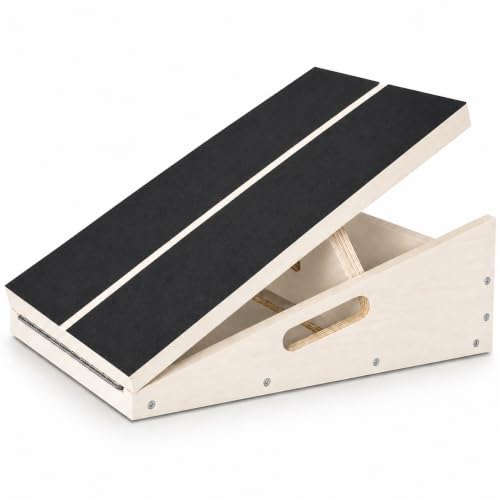
- Five angles from 15 to 35 degrees
- 500-pound stated capacity
- Textured top and slip-resistant base
Best For: Calf stretching, ankle mobility, squats, and warm-ups
Best Slant Board Set

- Five adjustable angles up to 45 degrees
- Includes two resistance bands and guides
- Portable wood design with non-slip surfaces
Best For: Calf mobility, stretching, rehabilitation, and band-assisted training
Best Portable Pick

- Folds with a carry handle and magnetic closure
- Four angles from 20° to 40°
- Stated 500-pound capacity with non-slip features
Best For: Portable stretching and mobility sessions
Best Angle Range
Portable Wooden Calf Stretcher
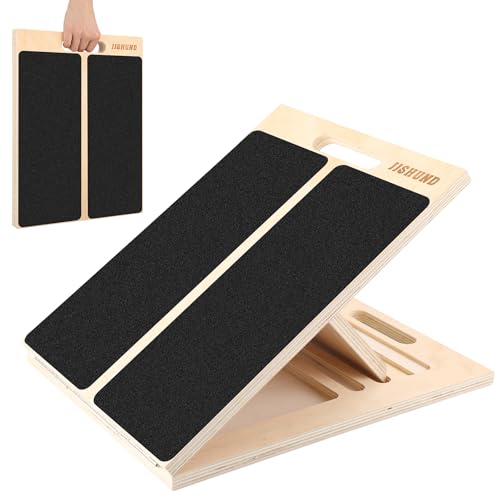
- Five adjustable angles up to 45°
- Foldable design with a hollow handle
- Anti-slip top and bottom surfaces
Best For: Progressive calf and ankle stretching
Best for Rehabilitation

- Four adjustable angles for mobility and squats
- Stated 500-pound capacity and hardwood construction
- Built-in handle with a non-slip surface
Best For: Rehabilitation and lower-body mobility training
Best Overall Wooden Slant Board – Adjustable StrongTek
This StrongTek wooden slant board is a versatile choice for calf stretching, squats, warm-ups, and basic rehabilitation work. Its five incline settings, non-slip treads, and side handle make it practical for home use or portable training.
Best For: Users who want a durable, adjustable wooden board for stretching, mobility work, and recovery exercises.
Pros:
- Five adjustable positions from 15 to 35 degrees
- High-quality Lauan hardwood plywood construction
- Anti-slip surface and convenient side handle
- Arrives assembled and ready to use
Cons:
- At 9 pounds, it is heavier than foam wedge alternatives
- The 12.5-inch width may feel limited for some wide stances
Choose this model if long-term wooden construction and adjustable positioning matter more than minimizing weight. It offers a stable, ready-to-use platform for progressive calf and ankle stretching.
Best Lightweight Foam Slant Board – Portable Squat Wedge
This lightweight slant board uses a portable EPP foam design for calf stretching, ankle mobility, squats, and physical therapy exercises. Its foldable, wipe-clean construction is convenient for users who need a compact option for home, office, or travel.
Best For: Travelers, office users, and beginners seeking an inexpensive, lightweight wedge with multiple angle options.
Pros:
- Weighs about 1 pound for easy portability
- Offers five angle options from 8.5 to 180 degrees
- Supports up to 960 pounds according to the supplied specifications
- Waterproof, oil-proof, recyclable, and easy to clean
Cons:
- The foam design may feel less substantial than a wooden board
- Its smaller 12-by-6-inch format provides less standing space
This is a practical pick when portability and easy storage are priorities. The compact wedge format suits targeted calf and ankle work, while the varied angles allow users to adjust stretching intensity.
Best Foldable Wooden Slant Board – StrongTek Wide Platform
This StrongTek slant board combines a 13-inch-wide platform with five settings from 15 to 35 degrees. A high-grip top, rubberized bottom pads, reinforced laminated wood, and a foldable carry-handle design make it suited to progressive mobility work and strength training.
Best For: Users who want a wide, sturdy wooden board that folds for storage and supports regular workouts.
Pros:
- Extra-wide 13-inch platform for squats, lunges, and calf raises
- Five adjustable incline settings
- Top and bottom anti-slip features help improve stability
- Supports up to 350 pounds and folds for compact storage
Cons:
- At 5.3 pounds, it is not the lightest portable option
- Wood construction may be less forgiving than foam for bare-foot use
Consider this model if stance room and a secure base are key buying priorities. Its combination of adjustable angles, reinforced wood, and folding storage makes it a balanced option for home gyms and clinics.
Best Heavy-Duty Slant Board – EVERYMATE 1000-LB
The EVERYMATE slant board is a wide hardwood platform designed for calf stretching, ATG and VMO squats, weighted exercises, and mobility work. Its full sandpaper top, non-slip baffle, and reinforced underside are aimed at providing a secure base during higher-load training.
Best For: Lifters and experienced users who need a wide, high-capacity board for squats and stretching.
Pros:
- 19.7-inch width provides ample standing room
- Rated for up to 1,000 pounds in the supplied specifications
- Full anti-slip treads, baffle, and base support grip
- Hardwood plywood with ribbed underside panels for durability
Cons:
- Only one level is listed in the supplied details
- At about 6.9 pounds, it is heavier than compact wedges
- The full sandpaper surface may be less comfortable for some barefoot users
This board stands out for users who prioritize platform width and load capacity over fine angle adjustment. Its sturdy construction and multiple handholds make it useful for demanding home-gym, gym, and rehabilitation routines.
Best Writing Slant Board – Classroom Handwriting Support
If you are shopping for slant boards to support writing and reading, this lightweight classroom model provides a fixed 20-degree angle. Its 13-by-13-inch surface, removable paper clip, and non-slip rubber strip make it practical for everyday desk work.
Best For: Children who need a portable writing and reading aid for improved positioning, posture, and handwriting practice.
Pros:
- Fixed 20-degree angle supports a more ergonomic writing position.
- Large 13-by-13-inch surface and removable clip accommodate up to 20 sheets.
- Lightweight plastic construction weighs less than 1.5 pounds and stacks easily.
- Non-slip rubber strip is easy to clean.
Cons:
- The angle is not adjustable.
- Its writing-focused design is not intended for calf stretching or fitness exercises.
This is a straightforward choice for school, therapy, or home writing stations. Choose it when portability and handwriting support matter more than adjustability or exercise versatility.
Best Adjustable Slant Board – Wooden Calf Stretch Board
Among slant boards for mobility work, this wooden calf stretch board stands out for its five adjustable angles, from 15 to 35 degrees. The textured top, slip-resistant base, and reinforced construction support controlled stretching, calf raises, squats, and warm-ups.
Best For: Home or gym users who want an adjustable platform for calf stretching, ankle mobility, rehabilitation, and strength routines.
Pros:
- Five angle settings allow gradual progression from gentle to deeper stretches.
- Wooden construction supports up to 500 pounds.
- Textured standing surface and slip-resistant base improve foot contact and stability.
- Side handles, exercise guide, and three-year warranty add practical value.
Cons:
- At 3.85 kg, it is heavier than lightweight portable writing boards.
- Its rectangular 16-by-12.5-inch platform may require dedicated storage space.
This is a versatile, sturdy option for users who want one board for stretching and lower-body mobility. The five settings make it easier to tailor intensity across fitness or rehabilitation routines.
Best Slant Board Set – Calf Stretch Board With Bands
This slant board combines adjustable incline training with resistance-band work. It offers five angles from 23 to 45 degrees, a non-slip EVA base, a PVC sandpaper surface, and two latex-free TPE bands for stretching, rehabilitation, and mobility exercises.
Best For: Adults who want a portable calf and ankle mobility setup with adjustable intensity and included resistance bands.
Pros:
- Five angle settings provide progression from easier to more challenging stretching.
- Includes two bands with different stated tension levels, plus an exercise guide and manual.
- Poplar wood construction weighs about 4.5 pounds for easier transport.
- Non-slip surfaces support calf stretching and squatting exercises.
Cons:
- The listed maximum weight differs between the product bullets and specifications.
- Its angle range starts at 23 degrees, so it does not offer the lower 15-degree setting of some boards.
- It has a one-year warranty, shorter than the three-year warranty on some alternatives.
This set is appealing if you want more than a basic incline platform. The included bands expand training options, while the adjustable angles accommodate different exercise preferences and experience levels.
Best Portable Pick – Frylr Folding Slant Board
If you want slant boards that are easy to store and carry, the Frylr is a practical option. Its folding wooden design includes a carry handle, magnetic closure, four incline settings, and a claimed 500-pound capacity for stretching, mobility work, and squat practice.
Best For: Home, office, or gym users who prioritize portability, adjustable angles, and a high stated weight capacity.
Pros:
- Folds to about 11.8 × 15.7 × 1.2 inches and includes a carry handle.
- Offers four fixed angles: 20°, 25°, 30°, and 40°.
- Uses layered wood, a wide non-slip surface, and bottom grip pads.
- Supports a stated load of up to 500 pounds.
Cons:
- It weighs about 5 pounds, so it is portable but not ultralight.
- Its four angle settings provide less adjustment than some five-position boards.
The Frylr stands out among slant boards for its folding format and substantial stated capacity. It is a strong fit when convenient storage and transport matter as much as dependable positioning for daily mobility work.
Best Angle Range – Portable Wooden Calf Stretcher
Among adjustable slant boards, this portable wooden calf stretcher offers five clearly defined angles for progressing from gentle mobility work to deeper stretching. Its enlarged anti-slip surface, bottom pad, and foldable design make it suitable for home, office, gym, or outdoor use.
Best For: Users who want five incline choices, including a 45-degree setting for deeper stretching.
Pros:
- Provides five angles: 20°, 30°, 35°, 40°, and 45°.
- Folds to 15.5 × 11.6 × 1.45 inches and has a hollow carry handle.
- Features anti-slip sandpaper on top and an anti-slip pad underneath.
- Its triangular structure and multilayer solid wood construction support up to 200 pounds.
Cons:
- The stated 200-pound load limit is lower than the capacity listed for the other featured boards.
- At 4.8 pounds, it may feel somewhat substantial for frequent carrying.
This board is a sensible choice if angle selection is your main priority. The extra 45-degree position gives it useful range for users who want to gradually increase stretching intensity while keeping the board compact and foldable.
Best for Rehabilitation – TEMI Wooden Incline Wedge
The TEMI is one of the more versatile slant boards for calf stretching, foot and ankle mobility, squat positioning, and recovery routines. It combines a portable hardwood wedge with four angle settings, a non-slip surface, and a stated 500-pound capacity.
Best For: Mobility training, squat practice, and rehabilitation-focused routines that benefit from a sturdy adjustable wedge.
Pros:
- Offers 20°, 25°, 30°, and 40° incline positions.
- Uses top-grade natural hardwood with a stated 500-pound capacity.
- Includes a built-in handle and weighs about 5 pounds for transport.
- The soft non-slip surface supports stable squats, heel stretches, and ankle drills.
Cons:
- It has four settings rather than the five offered by the portable calf stretcher.
- The product is not described as folding in the supplied specifications.
The TEMI balances sturdy construction with practical portability. Its rehabilitation-oriented positioning and broad range of lower-body uses make it a good choice for shoppers seeking one slant board for stretching, squat mechanics, and mobility work.
How We Picked the Best Slant Boards
We compared these Slant Boards based on construction, incline design, stability, surface traction, portability, weight capacity, and intended use. We also considered whether each board is better suited to stretching, strength training, ankle mobility, rehabilitation-style exercises, or desk and handwriting support.
Because users have different goals, there is no single best design for everyone. Adjustable boards offer more flexibility, while fixed wedges are often simpler, lighter, and faster to use.
Quick Comparison
| Best For | Look For | Most Suitable Design |
|---|---|---|
| Calf stretching | Stable base and grippy surface | Fixed or adjustable wedge |
| Squats and weight training | High weight capacity and firm construction | Heavy-duty wooden or reinforced board |
| Ankle mobility | Multiple angles and controlled positioning | Adjustable incline board |
| Travel or storage | Foldable, compact, and lightweight build | Portable folding model |
| Handwriting support | Stable sloped writing surface | Purpose-built writing board |
Key Buying Factors for Slant Boards
Angle and Adjustability
A steeper angle generally creates a stronger calf and ankle stretch, but beginners may prefer a lower setting. Adjustable Slant Boards are useful when several people share the equipment or when you want to progress gradually.
Stability and Traction
Look for a broad base, non-slip feet, and a surface that keeps your heels or shoes positioned securely. Stability matters especially during squats, loaded movements, and extended stretches.
Weight Capacity
Check the stated capacity against your body weight plus any dumbbells, barbells, or other equipment. A generous rating can provide a useful safety margin, but it does not replace controlled technique or proper placement.
Materials and Portability
Wooden boards can feel sturdy and durable, while foldable designs are easier to store and carry. Consider board width, folded dimensions, handle placement, and whether the board will fit your workout or work area.
Intended Use
Some models are designed primarily for calf stretching and heel elevation, while others support resistance-band work, squats, or handwriting. Choose a purpose-built design when positioning and surface shape are especially important.
Who Should Buy Which Slant Boards?
- Choose an adjustable board if you want multiple stretch levels, shared use, or a way to progress gradually.
- Choose a heavy-duty wedge if your priority is loaded squats, frequent training, or a higher stated weight capacity.
- Choose a portable folding model if you need to store the board easily or take it to a gym, office, or class.
- Choose a resistance-band model if you want to combine calf stretching with light mobility or strengthening exercises.
- Choose a writing slant board if your primary goal is a more ergonomic, elevated surface for handwriting and desk activities.
Before buying, measure your available space and confirm the angle range, dimensions, capacity, and traction features. If you have pain or an injury, consult a qualified professional before adding aggressive stretching or loaded mobility work.