Choosing among treadmills for seniors means looking beyond motor power and top speed. Stable handrails, simple controls, gentle starts, shock absorption, and an easy-to-use safety system can make home walking more comfortable and confidence-inspiring.
We selected 10 options with senior-friendly features ranging from extended support rails and low starting speeds to folding frames, wide decks, incline settings, and higher weight capacities. Use the guide below to match the right treadmill to the user’s mobility, space, and exercise goals.
Best 10 Treadmills for Seniors Picks for 2026
Best Stability Pick
Redliro Long-Handrail Walking Treadmill

- Extended side and front handrails
- 0.3 MPH starting speed
- Foldable design with LCD tracking
Best For: Seniors and rehab users seeking extra walking support
Best Smart Workout Option
NordicTrack T Series Treadmill

- 0–10 MPH speed range
- 0–10% power incline
- Optional iFIT guided training
Best For: Active seniors wanting progression and connected workouts
Best Low-Impact Design
Redliro 0.3 MPH Senior Treadmill

- Starts at 0.3 MPH
- Flat lowest incline setting
- Front and long side handrails
Best For: Limited-mobility and rehabilitation walking
Best App-Tracking Value

- Sturdy handrails and safety lock
- 0.5–5.5 MPH walking range
- MERACH app and heart-rate tracking
Best For: Recovery users wanting simple connected progress tracking
Best Compact Support
Redliro Senior Treadmill with Long Handrails
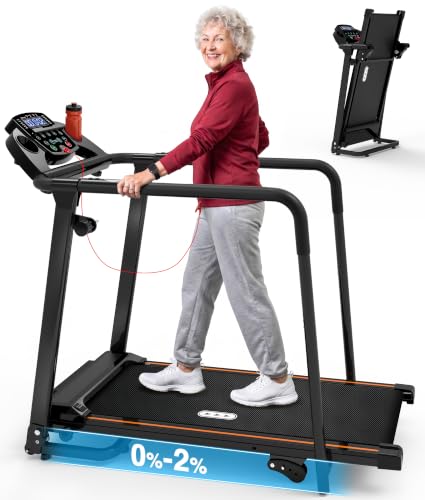
- Extended handrails support balance during walking
- 0–2% manual incline for gentle intensity changes
- Folding, wheeled frame fits smaller spaces
Best For: Supported indoor walking in compact homes
Best Shock Absorption
FYC Senior Treadmill with Extended Handrails

- Six-layer belt and spring deck absorb impact
- Low-profile platform and safety key add protection
- 12 programs plus optional app-based tracking
Best For: Cushioned walking and shared family use
Best for Easy Maintenance
Redliro Senior Treadmill with 12 Programs

- Long handrails support balance and confidence
- Three manual incline levels from 0% to 2%
- Accessible lubrication port and folding storage design
Best For: Low-maintenance daily walking at home
Best for Full-Length Support
YESOUL Senior Walking Treadmill

- Full-length handrails and emergency stop protection
- Six-layer cushioning for low-impact walking
- Quiet motor with LED tracking and app connectivity
Best For: Seniors and recovery users wanting supported, gentle home walking
Best Foldable Option
2.5HP Senior Walking Treadmill

- Extra-long handrails with magnetic safety key
- Dual shock absorption and pulse monitoring
- Folds and rolls away for compact storage
Best For: Seniors wanting support, storage convenience, and light-jogging flexibility
Best for Very Slow Walking

- Starts at 0.3 mph for gradual pacing
- Supports forward and backward walking on a flat deck
- Extended handrails and handrail speed controls
Best For: Seniors and recovery users needing highly controlled movement
Best Stability Pick – Redliro Long-Handrail Walking Treadmill
For shoppers comparing treadmills for seniors, this Redliro model emphasizes stability and gentle pacing. Its extended side rails, front handrail, 0.3 MPH starting speed, and shock-absorbing belt make it suited to controlled home walking.
Best For: Seniors, rehabilitation users, and households wanting extra handrail support.
Pros:
- Dual extended side rails plus an ergonomic front handrail provide continuous support.
- Starts at 0.3 MPH and supports users up to 300 pounds.
- Backlit LCD tracks speed, distance, time, calories, and heart rate.
- Folds after handrail removal and includes transport wheels.
Cons:
- The 16-inch-wide, 41-inch-long deck is relatively compact.
- Its maximum speed is 5.5 MPH, so it is geared more toward walking than fast running.
This is a practical choice when stability and low-speed control matter more than advanced connectivity or a large running surface.
Best Smart Workout Option – NordicTrack T Series Treadmill
Among treadmills for seniors, the NordicTrack T Series is better suited to users who want guided workouts and room to progress. It offers speeds up to 10 MPH, a 0–10% incline range, cushioning, and optional iFIT-connected features.
Best For: Active older adults who want walking, incline training, and app-guided workouts.
Pros:
- KeyFlex cushioning is designed to reduce joint impact.
- Offers a 0–10 MPH speed range and 0–10% incline.
- Optional iFIT features include guided workouts and automatic speed and incline adjustments.
- The 55-inch deck provides more room than compact walking treadmills.
Cons:
- Many smart features require an iFIT Train Membership.
- At 130 pounds, it is heavier than the compact Redliro models.
- It does not list the extended senior-focused handrail system found on the Redliro treadmills.
This model makes the most sense for seniors who are comfortable with technology and want a treadmill that can support both walking and more demanding cardio sessions.
Best Low-Impact Design – Redliro 0.3 MPH Senior Treadmill
This Redliro is one of the more senior-focused treadmills for seniors, combining a 0.3 MPH slow start with front and long side handrails. Its flat lowest incline setting, assisted folding design, and pulse sensors support gentle home walking and recovery routines.
Best For: Users with limited mobility, joint concerns, or rehabilitation needs.
Pros:
- The 0.3 MPH minimum speed enables a highly controlled start.
- Front and extended side handrails provide added balance support.
- The lowest manual incline setting creates a flat walking surface.
- Gas-spring folding, wheels, and an accessible oil port simplify storage and maintenance.
Cons:
- The deck measures 16 by 41 inches, which may feel narrow or short for some users.
- Manual incline adjustment requires setting a rear pin rather than using powered controls.
Choose this version when gentle pacing, a flat walking surface, and easy storage are higher priorities than a larger deck or advanced workout programming.
Best App-Tracking Value – MERACH T12 Foldable Treadmill
The MERACH T12 is a solid option for shoppers seeking treadmills for seniors with straightforward safety features and progress tracking. It combines sturdy handrails, a safety lock, a 300-pound capacity, gentle speeds, heart-rate monitoring, and MERACH app integration.
Best For: Seniors and recovery users who want simple walking workouts with app-based tracking.
Pros:
- Sturdy handrails and a safety lock support a more secure workout.
- The 0.5–5.5 MPH range is appropriate for gentle walking and light exercise.
- Built-in heart-rate sensors and body-fat analysis provide additional tracking.
- Transport wheels and a foldable design help with moving and storage.
Cons:
- Its minimum speed of 0.5 MPH is higher than the Redliro models’ 0.3 MPH start.
- The supplied details do not specify a manual or powered incline range.
- The product is listed at 86 pounds, so moving it may still require effort.
This treadmill is a good middle ground for users who want senior-friendly support and app tracking without stepping up to a more technology-heavy training platform.
Best Compact Support – Redliro Senior Treadmill with Long Handrails
For shoppers comparing treadmills for seniors, this Redliro model prioritizes stability, straightforward controls, and easy storage. Its extended handrails, gentle 0–2% manual incline, and compact folding frame suit home walking routines where balance support and space efficiency matter.
Best For: Seniors who want supported, low-impact walking in a compact home treadmill.
Pros:
- Extended handrails provide continuous grip assistance for added balance support.
- Manual 0–2% incline allows users to adjust walking intensity gradually.
- Folding frame and transport wheels simplify storage and relocation.
- Mute and screen-off controls create a quieter, less distracting experience.
Cons:
- The 39.3-inch deck is primarily suited to walking rather than long-stride running.
- Incline adjustment is manual, so it must be changed before walking.
With a 5 mph maximum speed, 300-pound capacity, and simple progress tracking, this is a practical choice for steady indoor walking. Its strongest advantage is the combination of long handrails and a lightweight, space-saving design.
Best Shock Absorption – FYC Senior Treadmill with Extended Handrails
This FYC model stands out among treadmills for seniors for its extended handrails, low-profile platform, and layered shock-absorbing running surface. It also offers a larger speed range and family-friendly programs, making it suitable for households with varied exercise needs.
Best For: Seniors who value cushioning and safety features, with flexibility for other household users.
Pros:
- Six-layer belt and eight spring shock absorption help reduce impact during walking.
- Extended handrails, a low-profile deck, and safety key support safer use.
- Large backlit display and simple buttons make core controls easier to read and operate.
- Includes 12 preset programs, Bluetooth, and optional Fit Show app tracking.
Cons:
- Its 7.5 mph maximum speed may be more capability than some senior walkers need.
- The app and Bluetooth features may add complexity for users seeking only basic controls.
- At 66 pounds, it is heavier than some compact walking-focused models.
The FYC is a versatile pick when cushioning and family use are priorities. Its safety-oriented design is complemented by a 300-pound capacity, mobile rollers, and a two-year quality guarantee noted by the manufacturer.
Best for Easy Maintenance – Redliro Senior Treadmill with 12 Programs
For buyers seeking treadmills for seniors with simple daily operation, this Redliro combines long handrails with a compact folding design and senior-focused controls. Its three manual incline levels, quick-pause function, and accessible lubrication port support flexible home walking routines.
Best For: Seniors who want supported walking, gentle incline options, and convenient maintenance.
Pros:
- Extended handrails help improve balance and confidence while walking.
- Three manual incline levels—0%, 1%, and 2%—allow gradual intensity changes.
- Auto-lubrication features and an easy-access lubrication port simplify upkeep.
- Folding construction, transport wheels, and a 58.6-pound weight aid storage and movement.
Cons:
- The 39.3-inch walking belt is better suited to walking than extended running strides.
- Incline changes are manual rather than powered.
This model offers a balanced feature set for everyday indoor walking, including 12 programs, goal tracking, and a 300-pound capacity. The mute, screen-off, and quick-pause controls make it especially practical for users who prefer uncomplicated operation.
Best for Full-Length Support – YESOUL Senior Walking Treadmill
For shoppers comparing treadmills for seniors, the YESOUL SW10 emphasizes steady walking, simple controls, and built-in safety features. Its full-length handrails, emergency stop button, and low maximum speed make it suited to gentle home exercise and recovery-focused routines.
Best For: Seniors and rehabilitation users who prioritize surrounding handrail support and low-impact walking.
Pros:
- Long handrails extend along the sides and front for added stability.
- Emergency stop button and safety key provide quick-stop protection.
- Six-layer cushioning helps reduce impact on knees, hips, and ankles.
- Quiet 2.5HP brushless motor, LED display, phone stand, and cup holder support comfortable daily use.
Cons:
- Its 3.8 mph top speed is intended more for walking than faster jogging.
- The treadmill is non-foldable, which may limit storage options.
- The 15.75-inch belt width may feel narrow for some users.
The YESOUL is a focused choice for controlled walking rather than intense training. Its 300-pound capacity, safety-focused frame, and cushioning make it practical for home wellness routines, provided you have room for a non-folding treadmill.
Best Foldable Option – 2.5HP Senior Walking Treadmill
This treadmill stands out among treadmills for seniors by combining extra-long enclosed handrails with a foldable, wheeled design. It offers a broad speed range, shock absorption, pulse sensors, and a backlit console for users who want both support and more workout flexibility.
Best For: Seniors who need stable handrails but also want folding storage, heart-rate monitoring, and optional light jogging.
Pros:
- Extra-long handrails and a magnetic safety key add confidence during walking.
- Dual shock absorption combines a cushioned deck with a shock-absorbing belt.
- Backlit display, oversized buttons, and pulse sensors support easier monitoring.
- One-step folding and transport wheels suit apartments and smaller home gyms.
Cons:
- The 14.2-inch belt width is relatively narrow compared with some home treadmills.
- Its 42.6-inch assembled height may require careful placement for ceiling clearance.
- App features may be more than needed for users seeking only basic walking.
With speeds from 0.5 to 6 mph and a 300-pound capacity, this model can accommodate progression from gentle walking to light jogging. Its main advantage is versatility, especially when storage space and supportive controls are equally important.
Best for Very Slow Walking – Redliro Backwards Treadmill
The Redliro is a specialized option among treadmills for seniors, starting at just 0.3 mph and supporting both forward and backward walking. Its level deck, extended handrails, and handrail speed controls are designed for users who prefer gradual movement, balance practice, or rehabilitation-oriented exercise.
Best For: Seniors and recovery users seeking very low-speed walking, backward mode, and multiple ways to control the treadmill.
Pros:
- Starts at 0.3 mph with 0.1 mph adjustments for controlled pacing.
- Side and front handrails provide layered stability and support.
- Flat, no-incline design offers a gentle walking surface for daily movement.
- Handrail controls, screen-off button, mute function, wheels, and app compatibility improve usability.
Cons:
- Backward walking may require instruction and supervision for some users.
- The 89.8-pound frame is heavier than the other listed options.
- Its 57.09-inch length may require more floor space.
This is the most specialized pick of the three. The very low starting speed and reversible walking capability are useful for controlled routines, while the 5.5 mph maximum leaves room for faster walking; however, its larger, heavier frame is less convenient to move and store.
How We Picked These Treadmills for Seniors
We focused on features that matter most for safe, consistent home walking rather than judging treadmills solely by speed or horsepower. Our selection emphasizes long or extended handrails, gradual speed control, stable walking decks, emergency-stop features, shock absorption, and straightforward operation.
We also considered practical differences between compact walking treadmills and more substantial models. Folding frames can help in smaller homes, while wider belts, stronger weight capacities, and incline options may be more useful for regular workouts or multiple household users. Because product specifications and availability can change, confirm the current dimensions, capacity, warranty, and included accessories before purchasing.
Quick Comparison
| Feature | Why It Matters | Best For |
|---|---|---|
| Long handrails | Provides more continuous support while stepping on, walking, and slowing down | Users who value balance assistance |
| Very low starting speed | Allows a gentler transition from standing to walking | Older adults returning to exercise |
| Wide walking belt | Offers more room for comfortable, confident strides | Users who prefer extra lateral space |
| Folding frame | Makes storage easier when floor space is limited | Apartments and shared rooms |
| Higher weight capacity | Can provide additional structural margin and household versatility | Larger users or shared use |
| Incline adjustment | Adds workout variety and can increase effort without higher speed | Users seeking progression |
Key Buying Factors for Treadmills for Seniors
Handrails and Stability
Prioritize rails that are long enough to support the user before and after the belt begins moving. Check whether the frame feels stable, whether the rails are comfortably positioned, and whether the treadmill leaves enough clearance around both sides and the front.
Speed Control and Safety
A low starting speed, small adjustment increments, and a clearly labeled emergency-stop button are especially valuable. A safety key or clip can stop the belt if the user loses balance. Controls should be readable and reachable without leaning forward.
Deck Comfort and Dimensions
Shock absorption may reduce perceived impact, but the belt should also be long and wide enough for the user’s natural stride. Measure the available room and leave clear walking space around the machine. A heavier frame may feel more planted, while a compact model is easier to move.
Capacity, Maintenance, and Setup
Choose a stated weight capacity comfortably above the user’s weight, and verify that the treadmill can be delivered and assembled safely. Review lubrication requirements, noise expectations, return policies, and warranty coverage before ordering.
Who Should Buy Which Treadmills for Seniors?
Choose a long-handrail walking treadmill for someone who primarily wants gentle indoor walking and values continuous balance support. A model with a 0.3-mph start is a strong fit for users who need especially gradual speed changes or are rebuilding confidence.
For small homes, a foldable or portable treadmill may be the most practical choice, provided it remains stable and can be stored without creating a trip hazard. Users wanting more room or a higher capacity should look for a wide-belt model with a sturdy frame and appropriate clearance.
Incline-capable treadmills suit active users who want to increase workout difficulty gradually, while app-connected or larger training models are better for households seeking guided workouts and broader exercise features. Anyone with significant balance, joint, cardiac, or neurological concerns should consult a healthcare professional before beginning treadmill exercise and use supervision when appropriate.