The Teeter FreeStep Recumbent Cross Trainer is built for buyers who want a lower-stress cardio machine that still works both the upper and lower body.
If you are comparing a recumbent bike alternative and care more about joint comfort than pure intensity, this Teeter FreeStep review is worth a close look.
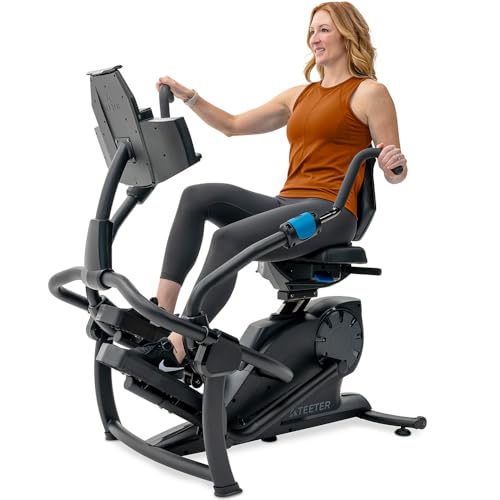
FreeStep Review Summary
The Teeter FreeStep makes sense for people who want gentler cardio without giving up a meaningful total-body workout.
Its defining advantage is the patented natural stride licensed from commercial physiotherapy steppers, paired with a seated position that the listing frames as easier on knees, back, hips, and ankles than a typical cycle motion.
That combination makes it especially relevant for home users who want to stay active despite joint sensitivity, limited tolerance for impact, or a preference for seated training.
It is also a strong fit for buyers who like guided workouts, because Teeter includes a free app with trainer-led classes and goal-based workouts on the console itself.
Review Scorecard
| Category | Score | Buyer-focused rationale |
|---|---|---|
| Joint comfort | 10/10 | The whole pitch centers on zero-impact movement and a natural stride designed to reduce stress on knees and back. |
| Full-body training | 9/10 | Dual power motion engages upper and lower body, so it does more than a basic seated bike. |
| Workout variety | 8/10 | 21 pre-programmed workouts plus app classes give it more structure than many home cardio machines. |
| Ease of use | 8/10 | Step lock, transport wheels, cup holders, and a media rack all support regular home use. |
| Resistance range | 8/10 | The 20-level magnetic system gives a useful spread for casual to more demanding sessions. |
| Comfort and ergonomics | 9/10 | The ComfortMax seat, pedal grip, and synchronized handles point to thoughtful long-session comfort. |
| Value for the right buyer | 8/10 | It is specialized, but the combination of joint-friendly mechanics and training features is well aligned to its audience. |
The main reason to buy it is simple: this is not trying to be the hardest cardio machine in the room, it is trying to be the one you can actually keep using.
If that is your priority, the balance of comfort, dual-action motion, and guided training is compelling.
Key Features and Specifications of FreeStep
The Teeter FreeStep is a home-use stepper and cross trainer with a seated design.
The listing emphasizes a patented natural stride inspired by physical therapy equipment, a zero-impact motion profile, and a total-body workout that lets you use arms and legs together or separately.
Here are the core facts buyers should know:
- Brand and model: Teeter FreeStep Recumbent Cross Trainer Stepper
- Primary use: Low-impact, seated cardio with upper- and lower-body engagement
- Resistance: 20-level magnetic resistance with quick-key console control
- Console: Color LCD screen with 7 tracking metrics and 21 pre-programmed workouts
- App support: Free Teeter Move app with trainer-led classes, subscription free
- User range: 4 ft 11 in to 6 ft 6 in
- Weight capacity: Up to 350 lb
- Comfort features: Extra-Large ComfortMax seat, SoftStep pedals, SureGrip handles
- Convenience features: Electronic step lock, cup holders, transport wheels, media rack with USB charging
The machine is also positioned as quiet in use, with the listing calling out whisper-quiet synchronized handles and pedals plus friction-free motion through UltraGlide bearings.
That matters if the machine will live in a shared room, apartment, or upstairs space.
The seat and entry details are also worth noting.
An electronic step lock is a practical addition for getting on and off the unit, and the adjustability of the media rack helps make longer sessions easier to stick with.
None of these details is flashy, but they are the kind that affect whether a machine gets used often or becomes a clothes rack.
Pros and Cons of FreeStep
Pros
- Very strong joint-friendly positioning for knees, back, hips, and ankles
- Dual power motion supports a genuine full-body workout
- 20 resistance levels make it easier to progress over time
- Free app classes add structure without a subscription
- Comfort-oriented design features suit longer sessions
- Large user and weight range broadens household fit
Cons
- The seated, low-impact design will not satisfy buyers who want a high-intensity upright climber or traditional spin-bike feel
- It is specialized equipment, so the value is strongest only if joint comfort is a real priority
- App and console workout libraries help, but they do not replace the variety of a full gym setup
- Its size and feature set suggest a dedicated home cardio station rather than something you would casually tuck away after every session
In practical terms, the pros are unusually concentrated around comfort and sustainability.
The cons are mostly about tradeoffs inherent to the format, not obvious product flaws.
Who Should Buy FreeStep?
Buy the Teeter FreeStep if you want a recumbent bike alternative that is easier on the joints but still feels purposeful.
It is a sensible pick for people who want to keep moving with a lower-impact machine, especially if standard cycle motion tends to feel harsher on the knees, hips, or back.
It also makes sense for users who appreciate built-in guidance.
The combination of 21 preset workouts, a metric-rich LCD screen, and the free Teeter Move app should appeal to people who do better with structure than with a blank console and no plan.
This machine should also be on the shortlist for households where different users need a broader fit range.
The listed support for users from 4 ft 11 in to 6 ft 6 in and up to 350 lb gives it a wider practical ceiling than many compact cardio options.
Skip it if you are chasing a very hard, standing cardio session, or if you specifically want the feel of a traditional spin bike, treadmill, or elliptical.
The FreeStep is intentionally about low-impact consistency, not maximal athletic punishment.
Low-Impact Training Details
Natural Stride and Joint Positioning
The standout idea behind the FreeStep is its patented natural stride.
Teeter says this motion is borrowed from commercial physiotherapy steppers and is intended to align the joints better than a typical recumbent bike or cross-trainer cycle pattern.
For anyone who has felt that certain cardio machines aggravate the knees or lower back, that is the central selling point.
Upper and Lower Body Balance
Dual power motion is not just a marketing phrase here.
The machine is designed so that your workout can engage both arms and legs together, distributing effort across more muscle groups.
That does not mean it replaces strength training, but it does mean the cardio session feels more complete than a leg-only seated pedal movement.
Resistance and Session Progression
The 20-level magnetic resistance gives the FreeStep a useful range for everyday progression.
Lower settings should suit recovery-minded or longer-duration cardio, while higher settings offer more challenge when you want a stronger training effect.
The quick-key control also matters because it reduces friction when changing effort mid-session.
Comfort for Regular Use
The ComfortMax seat, grip handles, SoftStep pedals, and step lock all support the same theme: make the machine easy to return to tomorrow.
That is often the difference between a machine that is technically impressive and one that becomes part of a routine.
If you are buying for consistency, those comfort details carry real weight.
Alternatives to FreeStep
If you want to compare the FreeStep against other recognizable options sold on Amazon, these are sensible search starting points:
- Nautilus recumbent exercise bike
- Schwinn recumbent bike
- Sunny Health & Fitness recumbent bike
- Cubii under desk elliptical
- Bowflex max trainer
These alternatives differ in important ways.
A recumbent bike is usually the closest comparison if you want seated cardio with a familiar pedal motion, while an under-desk elliptical is more about compact movement than a true full-body session.
A max trainer is the opposite direction: typically more aggressive and less joint-protective than the FreeStep.
Is FreeStep Worth It?
Yes, if your top priority is joint-friendly cardio that you can stick with long term.
The Teeter FreeStep is not the most aggressive machine, but it does a very specific job well: low-impact, seated, total-body training with more comfort features than a basic cardio bike.
It is worth considering if you want guidance, a wide resistance range, and a machine that can serve a broad set of users in one household.
It is less compelling if you mainly care about raw intensity or the feel of a standard upright cardio machine.
For the buyer it is built for, though, the FreeStep looks like a sensible and durable fit.