Mold spores can circulate through indoor air even after the visible source is removed. The right air purifier can help capture airborne particles and reduce musty odors, especially in damp rooms, basements, bedrooms, and homes with poor ventilation.
We compared 10 popular models by filtration, room coverage, odor control, noise, monitoring features, and maintenance needs to help you choose a practical fit for your space.
Best 10 Air Purifier for Mold Picks for 2026
Pet-Friendly Mold Defense

- Pet Pure HEPA filter targets mold spores and dander
- Activated carbon reduces household odors
- UV-C and quiet operation add versatility
Best For: Pet owners with medium-sized bedrooms or living areas
Large-Space UltraHEPA

- UltraHEPA filtration captures very fine airborne particles
- Premium carbon filter targets gases, VOCs, and odors
- Air-quality sensor enables Auto Mode and Boost
Best For: Large rooms and open living areas needing automated purification
Quiet Budget-Friendly Pick

- Three-stage filtration targets mold and common allergens
- Quiet 24 dB sleep mode with light-off function
- Touch timer and filter indicator simplify use
Best For: Bedrooms, nurseries, offices, and other small-to-medium rooms
Turbo Room Cleaner

- True HEPA captures 99.97% of allergens and particulates
- 360-degree intake supports even room coverage
- Turbo Timer provides quick 10- to 30-minute cleaning
Best For: Medium rooms needing fast, flexible purification
Best Multi-Stage Mold Defense

- H13 HEPA captures particles to 0.05 micron
- Multi-stage mold and odor filtration
- Quiet 25 dB operation with app control
Best For: Bedrooms and smaller rooms needing specialized filtration
Best Large-Room Value
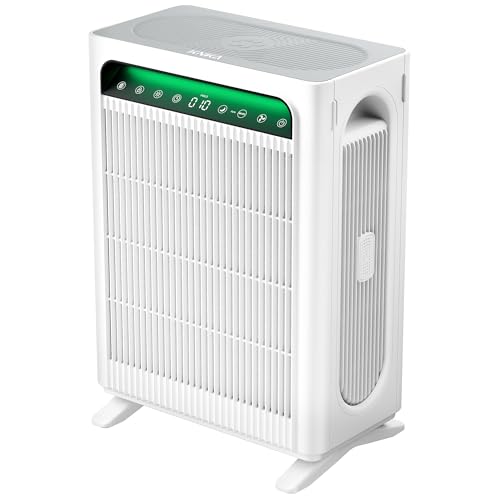
- AHAM-verified 226 CFM smoke/dust CADR
- Dual three-stage filters with washable pre-filters
- Quiet Sleep Mode and real-time AQI display
Best For: Large homes and pet owners wanting strong airflow
Best Smart Large-Room Pick

- Cleans up to 1,882 square feet in one hour
- True HEPA plus high-deodorization carbon filter
- Smart sensing, app control, and Auto Mode
Best For: Large rooms needing automated particle and odor control
Best Overall
Clorox Medium Room True HEPA Air Purifier

- True HEPA and carbon filtration
- Auto mode with PM2.5 display
- Best suited to medium rooms
Best For: Bedrooms and medium rooms needing particle and odor filtration
Best for Large Rooms
LEVOIT Vital 200S-P Smart Air Purifier

- AHAM VERIFIDE with listed CADR ratings
- Covers spaces up to 1,875 square feet
- Quiet 27 dB sleep mode and app control
Best For: Large rooms, open layouts, and pet households
Best Value Features
MOOKA PR1 H13 True HEPA Air Purifier

- H13 True HEPA and four-stage filtration
- Large stated coverage up to 2,200 square feet
- Pet Mode, PM2.5 display, and 26 dB sleep mode
Best For: Large pet-friendly spaces needing flexible operation
Pet-Friendly Mold Defense – GermGuardian AC4300WPT
If you need an air purifier for mold in a bedroom, dorm, or living area shared with pets, the GermGuardian AC4300WPT combines a Pet Pure HEPA filter with activated carbon and UV-C technology. It circulates air up to 4.8 times per hour in a 153-square-foot room and once per hour in rooms up to 743 square feet.
Best For: Pet owners seeking mold-spore, dander, dust, and odor filtration in medium-sized rooms.
Pros:
- HEPA filtration captures up to 99.97% of particles as small as 0.1 micron, including mold spores and allergens.
- Activated carbon helps reduce pet, smoke, and cooking odors.
- UV-C technology helps reduce airborne germs and mold spores.
- Low setting provides quiet operation suitable for nighttime use.
Cons:
- Its stated coverage is smaller than that of the largest-room models in this roundup.
- The UV-C bulb and filter require ongoing replacement maintenance.
The AC4300WPT is a practical choice when pet-related pollutants are as important as mold spores. Its three-speed design, quiet low setting, and included UV-C feature make it especially suitable for bedrooms and pet areas.
Large-Space UltraHEPA – AirDoctor AD3500
For shoppers looking for an air purifier for mold across a large home, the AirDoctor AD3500 offers UltraHEPA filtration, a premium carbon and gas-trap filter, and real-time air-quality monitoring. It is designed to clean 630 square feet in 15 minutes and up to 2,520 square feet in an hour.
Best For: Large bedrooms, kitchens, living rooms, and open areas where broad coverage and automatic control matter.
Pros:
- UltraHEPA filtration captures 99.99% of airborne particles at 0.003 microns, according to the supplied specifications.
- Premium activated carbon and potassium permanganate filtration helps reduce odors, gases, smoke, and VOCs.
- PM2.5 sensing, Auto Mode, Boost, and four fan speeds simplify operation.
- Quiet operation and a filter-change warning support day-to-day use.
Cons:
- It is a larger, more substantial unit than compact room purifiers.
- Replacement filters have different schedules, with carbon listed at six months and UltraHEPA at 12 months.
The AD3500 is the most coverage-focused option here and pairs mold-related particle filtration with stronger gas and odor control. Its sensor-driven automation is useful for users who want less manual adjustment in larger spaces.
Quiet Budget-Friendly Pick – Aurora AR100W
The Aurora AR100W is a compact option for shoppers seeking an air purifier for mold in a bedroom, nursery, office, or study. Its three-stage system is rated to capture 99.97% of airborne particles as small as 0.3 microns, while the unit can circulate air five times per hour in a 220-square-foot room.
Best For: Small to medium rooms where quiet sleep-mode operation and simple touch controls are priorities.
Pros:
- Three-stage filtration addresses mold, dust, pollen, allergens, germs, odors, and smoke.
- Rated coverage reaches up to 1,100 square feet at one air change per hour.
- Sleep mode operates as low as 24 dB, with a light-off function.
- Touch controls include a timer, display lock, and filter replacement indicator.
Cons:
- Its 0.3-micron particle rating is less fine than the UltraHEPA specification of the AirDoctor model.
- A replacement AR10F filter is required for continued operation.
With a small footprint, quiet sleep mode, and broad contaminant list, the AR100W fits everyday bedroom or office use. Its stated performance is strongest in smaller rooms where frequent air circulation is possible.
Turbo Room Cleaner – Clorox Medium Room Turbo
The Clorox Medium Room Turbo is a useful air purifier for mold when you want quick, adjustable cleaning in a medium-sized room. Its 360-degree intake, True HEPA filter, active carbon layer, and Turbo Timer are designed for rooms up to 1,000 square feet, with up to five air changes per hour in 215 square feet.
Best For: Medium rooms needing convenient high-speed cleaning for allergens, smoke, odors, and mold-related particulates.
Pros:
- True HEPA filtration captures 99.97% of allergens and particulates.
- Pre-filter and active carbon layers address larger particles, VOCs, and odors.
- Turbo Timer offers 10-, 20-, and 30-minute quick-cleaning periods.
- Four fan speeds and display brightness control allow flexible operation.
Cons:
- The supplied details do not specify a mold-spore particle size separate from its general filtration claims.
- Turbo operation is intended for rapid cleaning rather than the quietest setting.
The Clorox model stands out for straightforward controls and its dedicated Turbo Timer. It is a good fit for users who want to increase airflow temporarily after cooking, during wildfire smoke, or when indoor allergen levels rise.
Best Multi-Stage Mold Defense – Air Oasis iAdaptAir 2.0
The Air Oasis iAdaptAir 2.0 is a compact, ozone-free option for shoppers seeking an air purifier for mold. Its H13 True HEPA filter, carbon filtration, antimicrobial silver filter, bipolar ionization, and UV light provide a multi-stage approach to airborne particles, mold-related pollutants, and odors.
Best For: Smaller rooms, bedrooms, and buyers who want app control plus multiple mold-focused filtration technologies.
Pros:
- H13 True HEPA media captures particles as small as 0.05 micron.
- Combines carbon, antimicrobial silver, bipolar ionization, and UV light.
- Operates quietly at 25 dB and includes Auto Mode with real-time PM2.5 monitoring.
- Filter life can last up to two years, helping reduce replacement frequency.
Cons:
- Its listed 177 CADR is lower than the larger-room models in this roundup.
- Advanced features may be more than needed for shoppers seeking basic particle filtration.
With a compact design, quiet operation, and several filtration stages aimed at mold, particles, and odors, the iAdaptAir 2.0 is a strong fit when targeted features matter more than maximum airflow.
Best Large-Room Value – KNKA APH4000 Air Purifier
The KNKA APH4000 offers high airflow and dual three-stage filter cartridges for shoppers comparing an air purifier for mold in larger homes. Its washable pre-filters capture larger debris, while the high-efficiency and activated carbon layers address fine particles, odors, and VOCs.
Best For: Homes that need broad room coverage, washable pre-filters, and flexible Pet, Eco, Auto, and Sleep modes.
Pros:
- AHAM-verified CADR ratings reach 226 CFM for smoke, dust, and PM2.5 and 244 CFM for pollen.
- Dual air intakes and outlets support faster circulation.
- Washable pre-filters help capture pet hair and larger particles before the main filters.
- Sleep Mode runs at approximately 22–24 dB, and the built-in sensor displays real-time AQI.
Cons:
- Filters require replacement every three to six months.
- The supplied specifications list a 0.3-micron particle retention size, rather than the finer rating of some alternatives.
- Its highest stated purification efficiency is for rooms up to 350 square feet; larger coverage is described as one refresh per hour.
The APH4000 is a practical choice for buyers prioritizing airflow, room coverage, and easy pre-filter maintenance. For mold-related concerns, it should complement moisture control and removal of the underlying source.
Best Smart Large-Room Pick – WINIX 5520
The WINIX 5520 is a large-room air purifier for mold-related airborne particles, smoke, dust, and odors. It pairs a True HEPA filter with a high-deodorization carbon filter, washable pre-filter, air-quality sensing, and automatic fan control for low-effort everyday use.
Best For: Large rooms where smart monitoring, automatic operation, odor reduction, and broad stated coverage are priorities.
Pros:
- Designed to clean spaces up to 1,882 square feet in one hour.
- True HEPA filtration is rated to capture 99.99% of listed airborne allergens as small as 0.01 micron.
- Carbon filtration reduces VOCs and household odors from cooking, pets, and smoke.
- Smart app control, air-quality monitoring, Auto Mode, and a 23.5 dB low-speed setting add convenience.
Cons:
- The supplied notes do not specify a mold-specific filter stage.
- At 13.3 pounds, it is less portable than the compact Air Oasis model.
- Smart features require Wi-Fi and app setup.
The WINIX 5520 stands out for high coverage and automation. Its particle and odor filtration can support a cleaner indoor environment, but it is still important to address leaks, dampness, and visible mold directly rather than relying on an air purifier alone.
Best Overall – Clorox Medium Room True HEPA Air Purifier
If you need an air purifier for mold-related particles, the Clorox Medium Room Air Purifier offers a practical three-stage design with a True HEPA filter, pre-filter, and activated carbon layer. Its sensor-driven auto mode and PM2.5 display make it easy to monitor changing air quality in bedrooms and medium-size rooms.
Best For: Bedrooms and medium rooms up to 225 square feet, with occasional use in spaces up to 1,000 square feet.
Pros:
- True HEPA filtration captures 99.97% of particles as small as 0.1 microns, according to the supplied specifications.
- Three-stage, 360-degree filtration also targets larger particles, odors, VOCs, viruses, and bacteria.
- Auto mode adjusts fan speed using the air-quality sensor, with a PM2.5 display and color-coded indicator.
Cons:
- Its strongest stated room coverage is 225 square feet at up to five air changes per hour.
- The filter typically needs replacement every 6–12 months.
The Clorox is a balanced choice for shoppers prioritizing straightforward controls, odor reduction, and detailed air-quality feedback. Remember that an air purifier can reduce airborne particles but does not remove the underlying moisture source that allows mold to grow.
Best for Large Rooms – LEVOIT Vital 200S-P Smart Air Purifier
For shoppers comparing an air purifier for mold in a large living area, basement, or open-concept home, the LEVOIT Vital 200S-P stands out for its stated coverage and independently verified performance claims. It combines three-stage filtration with app control, air-quality monitoring, and quiet sleep operation.
Best For: Large rooms and open-concept spaces up to 1,875 square feet, especially homes with pets and allergy concerns.
Pros:
- AHAM VERIFIDE, with supplied CADR ratings of 250 CFM for smoke, 254 CFM for dust, and 289 CFM for pollen.
- Three-stage filtration targets dust, smoke, odors, pet hair, and dander.
- Runs as quietly as 27 dB in sleep mode and includes app control plus an air-quality monitor.
Cons:
- The supplied particle-retention specification is 0.3 micrometer, rather than the smaller figure listed for the Clorox model.
- The notes do not specify a mold-specific removal rate or filter replacement interval.
The Vital 200S-P is a strong fit when room size, smart features, and independently verified CADR figures matter most. Use it as part of a broader moisture-control plan rather than as a standalone solution for an active mold problem.
Best Value Features – MOOKA PR1 H13 True HEPA Air Purifier
The MOOKA PR1 is a feature-rich option for anyone seeking an air purifier for mold-related airborne particles across a large home. Its wider air intake, H13 True HEPA filtration, real-time PM2.5 display, and dedicated Pet Mode are designed for busy rooms with dust, pet hair, smoke, and odors.
Best For: Large bedrooms, living rooms, basements, apartments, and pet-friendly homes up to 2,200 square feet.
Pros:
- Four-stage filtration with an H13 True HEPA filter and washable pre-filter.
- Wider-sided air intake and Pet Mode are designed to handle pet hair and odors more efficiently.
- Offers six fan speeds, auto mode, a PM2.5 air-quality display, timer, child lock, and sleep operation as low as 26 dB.
Cons:
- Replacement filters are recommended every 3–6 months, which may increase ongoing maintenance.
- The aroma function adds fragrance but is not a substitute for odor or moisture control.
- The supplied details do not provide a specific mold-removal percentage.
MOOKA’s broad coverage and extensive controls make it appealing for larger, high-traffic spaces, particularly where pets contribute to airborne debris. Its washable pre-filter can help extend filter life, but regular cleaning and timely replacement remain important.
How We Picked the Best Air Purifier for Mold
We focused on models with True HEPA or H13 HEPA filtration, since these filters are designed to capture very small airborne particles, including many mold spores. We also considered activated carbon or other odor-reduction layers, because mold-related smells often require more than particle filtration.
Coverage claims were compared with room size, airflow features, and intended use. A purifier’s performance depends on ceiling height, doors, ventilation, and how frequently air is exchanged, so larger spaces may require a higher-capacity unit or multiple purifiers. We also considered controls, air-quality sensors, replacement-filter availability, noise settings, and ongoing operating costs.
Quick Comparison
| Best For | What to Prioritize |
|---|---|
| Bedroom or nursery | Low noise, sleep mode, dimmable controls, and appropriately sized coverage |
| Basement or damp room | HEPA filtration, carbon for odors, and easy filter replacement |
| Large open area | High airflow, broad stated coverage, and an automatic mode |
| Pet households | Washable prefilter, strong particle capture, and accessible replacement filters |
| Smart-home users | App controls, scheduling, air-quality monitoring, and automation |
Key Buying Factors for an Air Purifier for Mold
Filter Type and Airflow
Look for True HEPA or H13 HEPA filtration and enough clean-air delivery for the room. A compact purifier may work well in a bedroom but struggle in a large basement. If your room is near a model’s maximum rating, consider sizing up for faster circulation.
Odor Control
HEPA filters capture particles but do not remove every odor. Activated carbon can help reduce musty smells and some household gases, although its effectiveness depends on the amount and quality of carbon used. Replace filters on schedule, particularly in smoky, dusty, or mold-prone spaces.
Noise, Sensors, and Controls
Quiet sleep settings matter if the purifier will run overnight. An air-quality sensor and automatic mode can adjust fan speed as conditions change, while an app is useful for scheduling and remote control. These features are convenient but should not replace adequate filtration and airflow.
Maintenance and Mold Safety
An air purifier only treats airborne particles; it does not remove established mold or fix leaks and excess humidity. Address the moisture source, clean or remediate affected materials safely, and use a dehumidifier when necessary. Check filter costs and availability before buying, and avoid operating a unit with a saturated filter.
Who Should Buy Which Air Purifier for Mold?
Choose a quiet, compact model for a bedroom or office, especially if you value sleep mode and simple controls. For basements, family rooms, and other larger spaces, prioritize strong airflow, generous coverage, and carbon filtration for persistent odors. Pet owners should favor a robust prefilter and easily sourced replacement filters. Smart models are best for shoppers who want app scheduling and automatic monitoring, while a straightforward unit may be the better value for users who only need reliable continuous filtration.