Finding a running watch that fits a smaller wrist can make training more comfortable and everyday tracking less distracting. The best options balance a compact case with reliable GPS, readable data, useful battery life, and a secure band.
This roundup compares 10 running watches and fitness trackers across Garmin, Fitbit, and budget-focused options, so you can match your priorities—structured workouts, health tracking, or simple activity monitoring—to the right device.
Best 10 Running Watches for Small Wrists Picks for 2026
Best Overall

- Lightweight 43 mm case
- Built-in GPS and adaptive workouts
- AMOLED display with button controls
Best For: Runners wanting comprehensive training features in a compact design
Best Slim Fitness Tracker

- Minimalist, small-profile design
- Tracks sleep, stress, and activity
- Up to 10 days of battery life
Best For: Casual runners and wellness-focused users who carry a phone
Best Value Running Features
- Built-in GPS and wrist heart rate
- Up to two weeks of smartwatch battery
- PacePro and daily suggested workouts
Best For: Runners seeking dedicated training tools and long battery life
Best Budget Activity Tracker

- Slim 0.96-inch display
- Tracks steps, sleep, and heart rate
- Includes two strap colors
Best For: Budget users needing basic activity and wellness tracking
Best for Easy Setup

- Lightweight 37 g design with a 20 mm band
- Multi-satellite GPS and running-focused metrics
- Training plans plus up to 20 hours of battery life
Best For: Runners wanting structured training in a compact, lightweight watch
Best Budget Fitness Tracker

- 120+ exercise modes with all-day activity tracking
- Health, sleep, call, and message features
- Uses connected phone GPS for workout routes
Best For: Casual runners who want broad features at a budget-friendly price
Best Smartwatch Upgrade

- 42 mm case with a vivid AMOLED touchscreen
- Built-in GPS and 30+ sports apps
- Up to 11 days of battery with training and music features
Best For: Runners wanting a versatile Garmin smartwatch for training and daily wear
Best Feature-Rich Pick
MorePro Fitness Tracker for Small Wrists

- 112 sports modes with running metrics
- Two bands and 200+ watch faces
- Up to seven days of battery life
Best For: Runners wanting extensive tracking and customization
Best Lightweight Option
USMECBL 1.47-Inch Fitness Tracker

- Compact 1.47-inch OLED display
- 25 sports modes and automatic activity tracking
- Lightweight design with extended battery claims
Best For: Everyday fitness tracking on a lightweight band
Best Small-Display Choice

- Compact 1.10-inch AMOLED screen
- 25 sports modes with connected GPS
- Up to seven days of battery life
Best For: Runners preferring a discreet display and phone-connected routes
Best Overall – Garmin Forerunner 165
The Garmin Forerunner 165 is a strong all-around choice among running watches for small wrists, combining a lightweight 43 mm case with built-in GPS, wrist-based heart-rate tracking, and a bright AMOLED touchscreen. Its button controls and training features make it practical for runners who want guidance beyond basic pace and distance.
Best For: Runners who want a compact, feature-rich watch with adaptive training guidance and a vivid display.
Pros:
- Lightweight 43 mm design with a 1.38-ounce listed weight
- Built-in GPS, wrist-based heart rate, and 25+ activity profiles
- Up to 11 days of smartwatch battery life and 19 hours in GPS mode
- Personalized suggested workouts, Garmin Coach, recovery time, and training-effect insights
Cons:
- Some safety and tracking features require a compatible smartphone and network coverage
- Garmin Pay availability depends on supported countries and payment networks
The Forerunner 165 offers the most complete running package here, especially if you value training feedback, GPS accuracy, and smartwatch extras in a relatively small case.
Best Slim Fitness Tracker – Fitbit Inspire 3
The Fitbit Inspire 3 is a slim, minimalist alternative to larger running watches for small wrists. It tracks activity, heart rate, sleep, stress, and exercise modes, while its GPS connects through a smartphone rather than being built into the tracker.
Best For: Walkers, casual runners, and fitness users who prioritize a discreet band and wellness tracking over standalone GPS.
Pros:
- Small 0.76-inch display and slim minimalist design
- Up to 10 days of listed battery life
- Tracks 40+ exercise modes, heart rate, sleep, stress, and activity
- Includes both small and large bands
Cons:
- GPS is provided through a smartphone, not built into the tracker
- Some listed features require a compatible Apple or Android phone
The Inspire 3 is a comfortable choice for smaller wrists when everyday wellness metrics matter more than detailed, phone-free run tracking.
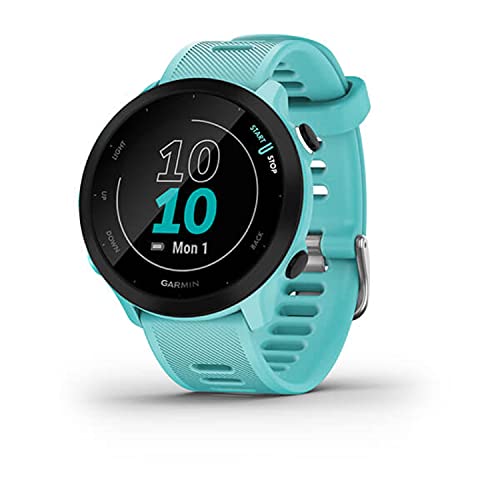
Best Value Running Features – Garmin Forerunner 55
The Garmin Forerunner 55 delivers dedicated running tools in a compact 1.65-inch case, making it a practical option among running watches for small wrists. It includes built-in GPS, wrist-based heart rate, PacePro guidance, race predictions, and daily suggested workouts.
Best For: Runners who want focused training tools, long battery life, and physical button controls without a touchscreen.
Pros:
- Built-in GPS and wrist-based heart-rate monitoring
- Up to two weeks in smartwatch mode and 20 hours in GPS mode
- Daily suggested workouts, race predictions, recovery guidance, and PacePro
- Button-based interface with multiple built-in sports profiles
Cons:
- Its display is a sunlight-visible MIP screen rather than an AMOLED touchscreen
- PacePro is not compatible with on-device courses
The Forerunner 55 is a sensible pick for runners who care about core training support and battery endurance more than a modern touchscreen experience.
Best Budget Activity Tracker – C68L Fitness Tracker
The C68L Fitness Tracker is a low-profile option for shoppers comparing running watches for small wrists on a budget. It records steps, distance, calories, heart rate, sleep, and blood oxygen, but its supplied notes do not list built-in GPS, so it is better suited to basic activity tracking than detailed run navigation.
Best For: Budget-conscious users who want basic fitness, sleep, and notification features in a slim tracker.
Pros:
- Slim-style design with a 0.96-inch display
- Tracks steps, distance, calories, heart rate, blood oxygen, and sleep
- IP68 water resistance for everyday use
- Includes black and white watch straps
Cons:
- Listed battery life is approximately five days
- The notes do not specify built-in GPS for standalone run tracking
- Companion app and notification features require a compatible smartphone
The C68L can work for basic movement goals and everyday reminders, but runners seeking reliable pace and route data should consider a GPS-equipped Garmin model instead.
Best for Easy Setup – Garmin Forerunner 55
For runners seeking running watches for small wrists, the Garmin Forerunner 55 offers a lightweight 37 g design, a compact 1.04-inch display, and dedicated training tools. Its built-in GPS supports multiple satellite systems, while suggested workouts and free training plans help structure your progress.
Best For: Runners who want focused training guidance, reliable route tracking, and long battery life in a lightweight watch.
Pros:
- Lightweight 37 g case with a 20 mm band
- GPS, GLONASS, and Galileo support for outdoor tracking
- Suggested daily workouts and free 5K, 10K, and half-marathon plans
- Up to 20 hours of battery life for running use
Cons:
- Smaller 1.04-inch LCD may feel less spacious for detailed data screens
- Uses button controls rather than a touchscreen
The Forerunner 55 is a practical choice when running performance matters more than smartwatch extras. Its compact, lightweight build and training-focused features make it especially appealing for smaller wrists.
Best Budget Fitness Tracker – H32 Pro Smart Watch
For shoppers comparing running watches for small wrists on a feature-rich budget, this fitness tracker combines a replaceable washable strap with a 1.58-inch display and more than 120 exercise modes. It uses your phone’s GPS connection for outdoor route maps rather than providing standalone GPS.
Best For: Casual runners who want broad health tracking, notifications, and phone-connected workout route recording.
Pros:
- More than 120 exercise modes and all-day activity tracking
- Tracks heart rate, blood oxygen, blood pressure, sleep, steps, distance, and calories
- Call and message notifications plus practical reminders and phone-finding tools
- Replaceable, washable strap with a secure clasp
Cons:
- Outdoor route maps require connection to a phone’s GPS
- The supplied notes do not specify the watch’s weight or case dimensions
- Health readings are fitness-tracking estimates, not medical measurements
This model suits everyday activity tracking and casual running, particularly if phone connectivity is acceptable. Its extensive exercise selection and smart notifications add versatility, but dedicated runners may prefer a watch with built-in GPS.
Best Smartwatch Upgrade – Garmin vívoactive 5
The Garmin vívoactive 5 is a strong option among running watches for small wrists, with a 42 mm case, silicone band, and a bright AMOLED touchscreen. It combines built-in GPS running support with health insights, recovery tools, adaptive training plans, and phone-free music storage.
Best For: Runners who want a compact Garmin smartwatch with training, wellness, music, and everyday-use features.
Pros:
- 42 mm case with a bright, colorful AMOLED display
- Built-in GPS and more than 30 indoor and GPS sports apps
- Garmin Coach adaptive plans, workout benefit, and recovery-time features
- Up to 11 days of smartwatch battery life and music storage for compatible services
Cons:
- Larger and likely heavier than the Forerunner 55, though the supplied notes do not state its weight
- Always-on display use reduces stated battery life to up to 5 days
- More features may be unnecessary for runners seeking a basic training watch
The vívoactive 5 offers the broadest smartwatch experience in this group. Its 42 mm format and built-in GPS make it suitable for many smaller wrists, while its wellness, training, and music features make it useful beyond the run.
Best Feature-Rich Pick – MorePro Fitness Tracker for Small Wrists
For shoppers comparing running watches for small wrists, this MorePro tracker offers a compact 1.57-inch touchscreen, extensive activity tracking, and practical smart features. It records running metrics such as distance, calories, speed, and workout duration, while connected GPS uses your smartphone rather than built-in GPS.
Best For: Runners who want broad health tracking, many workout modes, and smart notifications in a versatile everyday tracker.
Pros:
- 112 sports modes include running, walking, cycling, and gym workouts.
- Tracks heart rate, blood pressure, blood oxygen, sleep, steps, distance, and calories.
- Includes two bands, 200+ watch faces, call and app notifications, and up to seven days of battery life.
- IP68 water resistance helps handle everyday water exposure.
Cons:
- GPS is provided through a connected smartphone, not built into the watch.
- It is not recommended for swimming, diving, or showering.
- Health readings are for general wellness reference and are not medical measurements.
This is a strong all-around choice if you prioritize customization and activity variety. Its smartphone-dependent GPS and water-use limitations are worth considering before buying.
Best Lightweight Option – USMECBL 1.47-Inch Fitness Tracker
This lightweight tracker is a practical option among running watches for small wrists, with a 1.47-inch OLED display and a comfort-focused band. It supports running and other activities, automatically records steps, distance, and calories, and provides notifications without requiring a built-in GPS connection.
Best For: Users seeking a lightweight daily fitness band with basic running tracking, health monitoring, and extended battery life.
Pros:
- Offers 25 sports modes, including running, swimming, and yoga.
- Provides automatic heart rate, sleep-stage, blood oxygen, and blood pressure tracking.
- Supports call, text, and app notifications on iOS and Android devices.
- Provides up to seven days of continuous use according to the supplied notes, with longer regular-use figures also listed.
Cons:
- No built-in GPS is included.
- The supplied battery information gives different figures for continuous and regular use, so actual runtime may vary.
- Its health readings should be treated as wellness information rather than medical advice.
Its smaller OLED display and lightweight construction may suit runners who dislike bulky watches. Choose it if phone-connected tracking is acceptable and long wear time matters more than advanced GPS features.
Best Small-Display Choice – AMOLED Fitness Tracker
With its 1.10-inch AMOLED screen, this model is a particularly compact candidate among running watches for small wrists. It tracks steps, calories, distance, heart rate, and exercise time across 25 sports modes, while connected GPS can record a route through a paired phone.
Best For: Runners who prefer a very small display and want connected-GPS route tracking plus essential wellness features.
Pros:
- The 1.10-inch AMOLED display provides a compact, high-contrast interface.
- Includes 25 sports modes and connected GPS for recording workout routes.
- Tracks heart rate, sleep, steps, calories, distance, and exercise time.
- Offers IP68 water resistance, notifications, and up to seven days of battery life.
Cons:
- GPS requires connection to a smartphone.
- The smaller screen may show less information at once during a run.
- The supplied notes state there is no warranty.
This is the most compact-feeling option of the group based on display size. It makes sense for smaller wrists if you value a discreet AMOLED screen and do not mind bringing your phone for route tracking.
How We Picked the Best Running Watches for Small Wrists
We focused on the features that matter most when a watch must stay comfortable during runs and daily wear. Our comparison considers case size and overall wearability, GPS availability, heart-rate and sleep tracking, workout support, battery expectations, display usability, water resistance, and the practicality of each device’s companion app.
The selection includes dedicated GPS running watches, multipurpose smartwatches, slim fitness bands, and affordable activity trackers. Because features and accuracy can vary substantially between device types, buyers should prioritize the functions they will actually use rather than choosing by sensor count alone.
Quick Comparison
| Best For | Look For | Product Types in This Roundup |
|---|---|---|
| Structured run training | Built-in GPS, pace data, workout guidance, dependable battery | Garmin Forerunner models |
| Everyday wellness | Comfortable band, sleep metrics, heart-rate tracking, simple app | Fitbit Inspire and fitness bands |
| All-around fitness | GPS, sports profiles, notifications, health features | Garmin vívoactive 5 |
| Basic activity tracking | Step counting, calories, heart rate, low purchase price | Budget fitness trackers |
Key Buying Factors for Running Watches for Small Wrists
Case Size and Comfort
A smaller case generally sits more securely and is less likely to shift while running. Check the listed case diameter, band adjustment range, thickness, and weight. A watch that fits tightly without pinching is usually more useful than a larger model with extra features you rarely view.
GPS and Run Features
For outdoor runners, built-in GPS is important if you want pace, distance, route, and intervals without carrying a phone. Dedicated running watches typically offer more training tools than basic trackers, including suggested workouts, recovery information, or customizable data screens.
Health Tracking and Accuracy
Heart-rate, sleep, blood-oxygen, and other wellness readings can help identify trends, but they are not medical diagnoses. Treat blood pressure and similar estimates cautiously, and choose a device with a well-supported app if long-term trend tracking matters.
Battery, Display, and Water Resistance
Compare ordinary smartwatch or tracker battery life with GPS-use battery life, which is usually shorter. A bright, readable display helps during outdoor runs, while water resistance is useful for sweat, rain, and pool workouts. Confirm the manufacturer’s limits before swimming.
Who Should Buy Which Running Watches for Small Wrists?
Choose a Garmin Forerunner if running performance, GPS accuracy, training guidance, and workout data are your main priorities. The vívoactive line is a better fit if you want running tools alongside broader smartwatch and wellness features.
Choose a Fitbit Inspire-style band if comfort, discreet wear, and everyday health tracking matter more than advanced running metrics. Budget fitness trackers make sense for shoppers who mainly want steps, calories, heart rate, and sleep information at a lower price, but verify app compatibility and sensor claims before buying.